

Board Performance · 2025
In this section15 topics
- Compliance Monitoring — Overview1 item
- Prevention of Conflicts of Interest4 items
- Prevention of the Use of Inside Information4 items
- Anti-Corruption5 items
- Whistleblowing4 items
- Selection of Directors & Chief Executives7 items
- Selection of Independent Directors2 items
- Director Development2 items
- Evaluation of Board & Subcommittee Performance3 items
- Subcommittees1 item
- Meeting Attendance & Remuneration4 items
- Supervision of Subsidiaries & Associated Companies5 items
- Board Duty Performance — Overview1 item
- Audit Committee Duty Performance1 item
- Executive Committee Duty Performance1 item
Compliance Monitoring — Overview
Monitoring of Compliance with Other CG Policies & Guidelines
In 2025, there were no cases in which any director of the Company committed serious misconduct relating to ethical issues in violation of applicable regulations. There were also no news reports, penalties, accusations, or civil actions taken by regulatory authorities against the Company’s directors.
In addition, there were no cases in which independent directors or executive directors resigned due to corporate governance issues, and there were no instances of the entire Audit Committee resigning.
Prevention of Conflicts of Interest
Has the Company Acted to Prevent Conflicts of Interest?
Yes
Operations in the Past Year
The Company has in place a policy to prevent conflict of interest based on prudence, honesty, rationale and independence within the ethical framework for the Company’s interests. The policy stipulates that a person who may have conflict of interest and/or a connected person as well as related parties involving in a transaction who discloses the information on the interests of his/her own and related parties to the Company for acknowledgement and have no authority to approve the transaction in which he/she has interests.
The Company prescribes in the Board of Directors charter that the Board of Directors shall be responsible for ensuring non-conflict of interest between stakeholders of the Company and subsidiaries. In case that any director having conflict of interest in any transaction conducted with the Company or changes in his/her shareholding percentage, such director shall notify the Company immediately. Moreover, the assignment of authority, duties and responsibilities to any person shall not be characterized by the delegation of authority that allows the attorney to be able to approve the transaction that he/she or a person who may have conflict of interest may have interests or receive interests in any forms or have any other conflict of interest with the Company or subsidiaries, except for the approval of transactions which are conducted in accordance with the policy and the criteria approved by the shareholders’ meeting or Board of Directors.
In 2025, the Board of Directors established the criteria and procedures for reporting conflicts of interest of directors and executives as follows:
Initial Reporting: Directors and executives (as defined by the SEC) who are newly appointed are required to complete a Report on Conflict of Interest Form, providing accurate and truthful information, and to certify the accuracy of such information by signature (either handwritten or via electronic signature). The completed form must be submitted to the Office of the Company Secretary.
Reporting of Changes: Whenever there is any change to the reported information, directors and executives are required to report such changes (only in the relevant amended sections) by completing the Report on Conflict of Interest Form, certifying the accuracy of the updated information, and submitting the form to the Company Secretary within 14 days from the date of such change.
Reporting and Summary: The Company Secretary shall compile and summarize the conflict of interest information (including any updates) of directors and executives and report the same to the Board of Directors for acknowledgment on a semi-annual basis.
Upon receipt of the Report on Conflict of Interest Form from directors and executives, the Company Secretary shall acknowledge receipt by signature, retain the original copy for record-keeping, and deliver copies to the Chairman of the Board of Directors and the Chairman of the Audit Committee within seven business days.
The Company has a policy on connected transactions and transactions having conflict of interests as in accordance with the laws and regulations of SEC, Capital Market Supervisory Board, and SET which will also be disclosed in Form 56-1 One Report.
Number of Conflict-of-Interest Cases — Introduction
For the years 2023–2025, there were no cases or issues related to conflicts of interest.
Number of Conflict-of-Interest Cases
| Metric | Current Year | Previous Year | Two Years Ago |
|---|---|---|---|
| Total number of cases or issues related to conflicts of interest (cases) | 0 | 0 | 0 |
| Total number of cases or issues related to conflicts of interest (cases) | 0 | 0 | 0 |
Prevention of the Use of Inside Information
Has the Company Acted to Prevent the Use of Inside Information?
Yes
Operations in the Past Year
The Company conducts business under the principles of good corporate governance of the Stock Exchange of Thailand and places emphasis on the supervision of the use of inside information to be in accordance with the principles of good corporate governance. By adhering to these principles and ensuring the confidence of investors to receive equitable, timely and reliable information, the Company has established a policy of confidentiality, data protection and the use of inside information that all personnel shall be informed and follow procedures of confidential information protection. To prevent the disclosure of information and to identify the type of confidential information, the confidential documents and information must be managed and protected with specific methods accessible by both data creators and users.
In addition, the Company places great emphasis on safeguard of customer and business information to be confidential. It is prohibited to disclose such confidential information of customers to employees and outsiders. In case that is necessary to disclose confidential information to the public, approval must be obtained from Chief Executive Officer. This prohibition shall include trading, transfer or acceptance of transfer of the Company’s securities by using confidential information and/or inside information and/or enter into any other juristic acts using confidential information / or inside information of the Company which causes damage to the Company either directly or indirectly.
The Company’s directors, management and employees who receive inside information shall be prohibited from trading of the Company’s securities in a specific period, which has been complied since the year ended 2020 which is the first reporting period since the Company was listed in the Stock Exchange of Thailand. The Company Secretary and the Human Resource department shall notify those directors, management, and employees receiving inside information in advance to be aware of such prohibition period for trading of the Company’s securities. This shall include the prohibition of trading of the Company’s securities by oneself, spouses, minor children, whether it is direct or indirect trading (such as nominee or holding of securities through private funds) during the period when the Company is about to disclose significant information that may affect the Company’s share price such as 1 month prior to the date of disclosure of financial statements or operating results until 1 day after the date that the Company has disclosed financial statements or operating results to the Stock Exchange of Thailand to ensure that such information be disclosed to the public first. With this regard, the Company has established disciplinary penalty for those seeking benefits from the use of disclosure of the inside information causing damages to the Company, which may be penalized as required by law or by the Company through verbal warning, warning letter, probation, or termination of employment.
Simultaneously, the Company has monitored and studied rules, regulations and relevant laws and informed the changes (if any) to its directors and management to strictly perform duties in accordance with changing rules, regulations, and relevant laws.
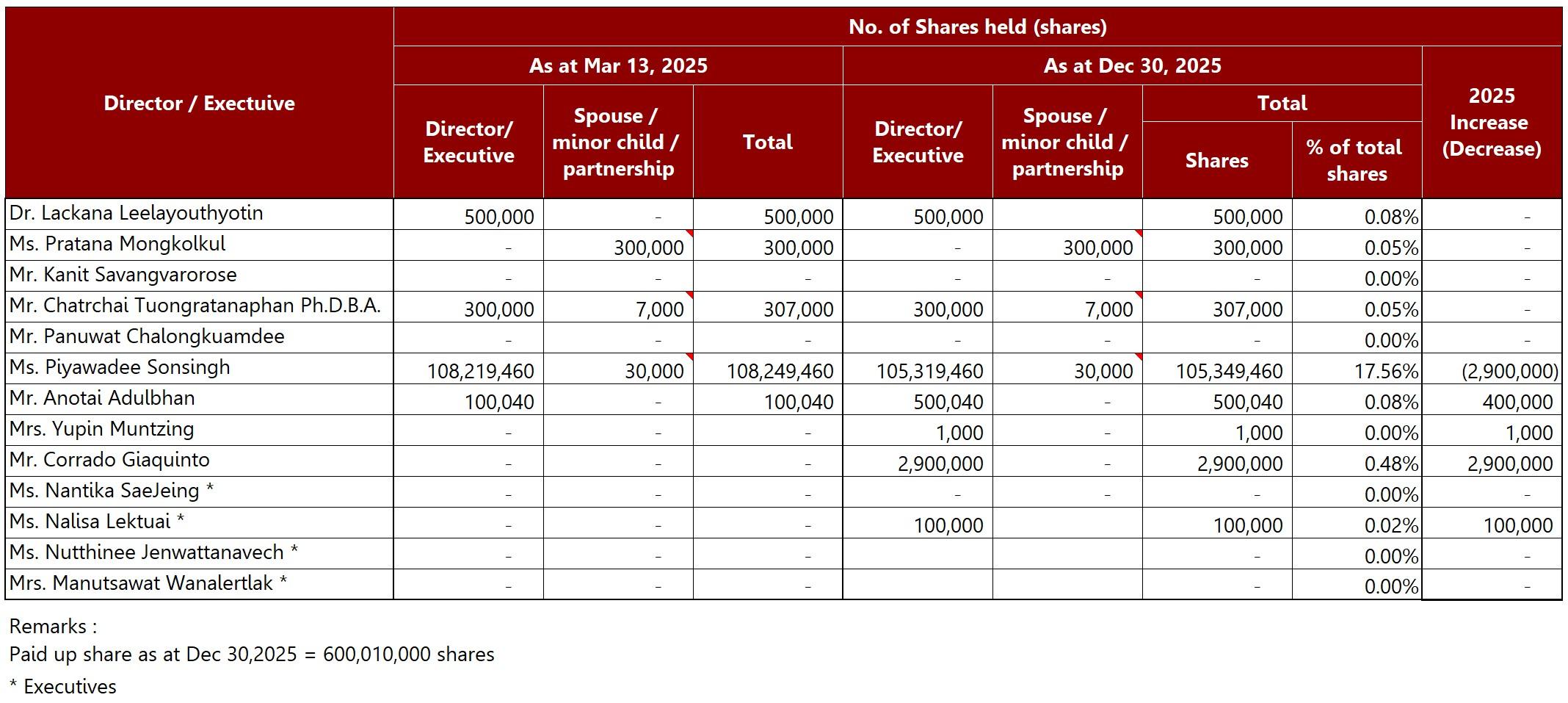
In 2025, the Company Secretary prepared and reported a summary of the “KISS” securities holdings of directors and senior executives to the Board of Directors on a quarterly basis for acknowledgment. Details of the changes in the holdings of “KISS” securities by directors and senior executives as of 13 March 2025 and 30 December 2025 are as follows:
Number of Inside-Information Cases — Introduction
For the years 2023–2025, there were no cases or issues related to the use of inside information to seek benefits.
Number of Inside-Information Cases
| Metric | Current Year | Previous Year | Two Years Ago |
|---|---|---|---|
| Total number of cases or issues related to the use of inside information to seek benefits (cases) | 0 | 0 | 0 |
| Total number of cases or issues related to the use of inside information to seek benefits (cases) | 0 | 0 | 0 |
Anti-Corruption
Has the Company Acted on Anti-Corruption?
Yes
Operations in the Past Year
The Company recognizes the importance of anti-corruption and is committed to operating business ethically within the goo corporate governance framework by adhering to good governance principles and Code of Conduct as well as responsibility for the society, the environment, and the stakeholders by ensuring business operations based on transparency, fairness, and accountability. The Company then developed a written anti-corruption policy which prescribes clear practice guidelines for operating business and transforming the organization into a sustainable organization. The policy was approved by the Board of Directors Meeting No. 3/2020 held on 22 June 2020, which can be summarized as follows:
Not taking any action in all forms of corruption, giving, or accepting bribery to government agencies and private sectors or stakeholders of the Company in order to gain competitive advantage or for own benefit and other related persons’ interests including requesting or giving bribery for any inappropriate benefits.
Not neglecting or ignoring when seeing actions that are considered a corruption in relation to the Company. Employees must notify the supervisor or the person in charge and cooperate in the investigation of various facts.
The Company will provide fairness and protection for employees who refuse or report a corruption cases to the Company in accordance with the policy established.
Person who commits corruption are against the Company’s code of ethics. He/she must be therefore considered for disciplinary action in accordance with the regulations set by the Company and may be punished by law if his/her act is illegal.
The Company recognizes the importance of disseminating and educating people to ensure they understand on their duties for the Company or possibly affecting the Company in matters of compliance with the anti-corruption policy. Human Resource Department is responsible for communication, education and ensure those people understand clearly on this matter.
The Company ensures appropriate and efficient auditing and internal control processes are put in place both financial and accounting system, keeping record and others. Also ensures that there is a risk management system to prevent corruption.
The Company set up communication channels to publish the anti-corruption policy to employees of the Company and its subsidiaries and external parties such as director and new employee orientation, posts on the Company’s publicity signs, corporate website, annual report etc. to ensure all related parties understand all kind of corruption, risk of having relation to corruption and how to report corruption case.
In order to clarify the operation in matters that have a high risk corruption, directors, executives and employees in all level of the Company have to operate with cautious in these following topics:
1 Political Support
The Company is politically independent and conducts its business without engaging in politics in any case. Therefore, the Company has no policy in supporting politics either directly or indirectly using money or any assets of the Company. However, the Company does not forbid directors, executives, and employees from participating in political activities undertaken under the constitution, but the participation must be on personal behalf without any negative association with the Company.
2 Charitable Donation and Financial Support
The Company can do charitable donation in the form of financial support or other forms such as sharing knowledge etc. and be a part of social return activities and do not request any benefit in return from donator and do not expect return on business. In order to give support in any form either money or assets to any activity or project, the Company has to proceed with transparent and follow the laws and based on the approval process as per company’s policy. The objective of the support must be for public relation, support business, the Company’s image and not for bribery.
The charitable donation and financial support need a clear and reliable evidence to ensure that the donation and financial support is not an excuse for corruption.
3 Gifts and Entertainment
The Company allows directors, executives and employees to accept and pay money for gifts and entertainment that are unambiguous and are considered as normal business conduct or traditions or festive without impact to business operation or being a potential channel for corruption. The act must be in accordance with the Company’s regulations without violation of related laws and notifications or with the purpose to gain any advantage through a misconduct or to be an outright on hidden exchange to seek benefits in any form. Moreover, type and value of gifts must be reasonable and appropriate.
Chief Executive Officer or the Audit Committee has duty to receive complaints, gather information, investigate and report to the Board of Directors for consideration and defining disciplinary action as appropriate. If such act is illegal, the person may be legally penalized. The decision of Chief Executive Officer or the Audit Committee is considered final.
Form of Anti-Corruption Operations
| Operation |
|---|
| Review of appropriateness in anti-corruption |
| Communication and training for employees on anti-corruption policy and guidelines |
Number of Corruption Cases — Introduction
For the years 2023–2025, there were no cases or issues related to fraud or corruption.
Number of Corruption Cases
| Metric | Current Year | Previous Year | Two Years Ago |
|---|---|---|---|
| Total number of cases or issues related to corruption (cases) | 0 | 0 | 0 |
| Total number of cases or issues related to corruption (cases) | 0 | 0 | 0 |
Whistleblowing
Has the Company Implemented Whistleblowing Procedures?
Yes
Operations in the Past Year
The Company has established mechanisms for receiving complaints and handling whistleblowing cases related to violations of laws, the Company’s charter, and its Code of Conduct and work ethics, or behaviors that may indicate fraud or corruption by the Company’s personnel. This includes appropriate protection measures for whistleblowers in accordance with this policy, in order to provide clear operational guidelines and to ensure that the handling of complaints regarding fraud and misconduct is carried out effectively.
Whistleblowers or complainants are required to provide details of the matter to be reported or complained of, together with their name, address, and contact telephone number, and to submit the information through the following channels:
Email: whistleblowing@rojukiss.com
By post to: Chairman of the Board of Directors or Chairman of the Audit Committee
Rojukiss International Public Company Limited
100/8, 100/51-54 Vongvanich Complex B Tower, 12th, 19th floor
Rama 9 Road, Huai Khwang, Huai Khwang, Bangkok 10310
Number of Whistleblowing Cases — Introduction
For the years 2023–2025, there were no cas regesarding whistleblowing.
Number of Whistleblowing Cases
| Metric | Current Year | Previous Year | Two Years Ago |
|---|---|---|---|
| Total number of cases or issues received through whistleblowing channels (cases) | 0 | 0 | 0 |
| Total number of cases or issues received through whistleblowing channels (cases) | 0 | 0 | 0 |
Selection of Directors & Chief Executives
Selection — Introduction
The Company provides shareholders with the opportunity to propose agendas for the shareholders’ meeting and to nominate qualified individuals for consideration for appointment as directors in advance. Such proposals were accepted during the period from 20 December 2024 to 31 January 2025. The criteria and procedures for making such proposals were disclosed on the Company’s website and announced through the Stock Exchange of Thailand’s information disclosure system (SETLink). It appeared that no shareholder proposed any agenda items or nominated any individual for consideration for election as a director.
In considering the appointment of directors, the Nomination and Remuneration Committee, which consists of two independent directors out of a total of three committee members, is responsible for identifying, screening, and selecting individuals who possess qualifications in accordance with the criteria specified in the Board of Directors’ Charter, as required by applicable laws, and in line with the Company's Board skill matrix designed to support its business strategies across various dimensions. In the case of independent directors, the Committee also considers the qualifications and independence of the proposed candidates.
Once the Nomination and Remuneration Committee has completed its comprehensive and thorough consideration, it will propose the nominated individuals to the Board of Directors for approval. The Board of Directors will then carefully and prudently review and scrutinize such nominations to ensure that the proposed candidates possess qualifications appropriate to the Company’s business, whether to fill a vacancy resulting from a director’s resignation with a remaining term of more than two months, or in the case of the reappointment of directors whose terms have expired, or the appointment of new directors to replace those whose terms have expired. The names of the approved candidates will subsequently be proposed to the shareholders’ meeting for election as directors.
The election of directors by the shareholders’ meeting shall be conducted in accordance with the following criteria and procedures:
Each shareholder shall have one vote per share held, with one share entitling the holder to one vote.
Shareholders may exercise all of their votes to elect one or more individuals as directors; however, the total number of individuals selected shall not exceed the number of directors to be elected at that meeting. In the case of voting for more than one candidate, shareholders may not allocate or divide their votes among the candidates.
The candidates receiving the highest number of votes, in descending order, shall be deemed elected as directors up to the number of directors to be elected. In the event that two or more candidates receive an equal number of votes resulting in more candidates than the number of directors to be elected, the Chairman of the meeting shall have the casting vote.
New directors are provided with a director orientation program to familiarize them with general corporate information, key aspects of the Company’s business operations, and a summary of performance across each business unit, presented by executives (C-Level). In addition, relevant Company information is made available to newly appointed directors, including compliance with applicable laws and regulations, such as the roles and duties of directors of listed companies, the Company’s securities trading policy, and other related policies.
Directors & Chief Executives — Introduction
The Board of Directors has considered and assigned the Nomination and Remuneration Committee to determine the criteria and procedures for identifying suitable candidates for the position of Chief Executive Officer and other top executive positions, and to propose qualified individuals, together with supporting rationale, for the Board of Directors’ consideration and appointment. In this regard, the Committee carefully screens and selects candidates who possess appropriate qualifications, knowledge, capabilities, skills, and experience that are beneficial to the Company’s operations, have a thorough understanding of the Company’s business, and are capable of effectively managing the organization to achieve the objectives and goals set by the Company.
In addition, the Company has established a succession planning policy for top management with the objective of assessing the readiness of personnel in terms of both qualifications and competencies, proactively planning for the identification, selection, replacement, and succession of key positions, and providing motivation and retention for high-potential employees who are capable of succeeding to critical roles. The Human Resources function is responsible for preparing the succession plans for the Chief Executive Officer and other senior executives, which are then submitted to the Nomination and Remuneration Committee for review and subsequently proposed to the Board of Directors for approval.
Are Directors Selected Through the Nomination Committee?
Yes
Are Chief Executives Selected Through the Nomination Committee?
Yes
Number of Directors from Major Shareholders
1
Rights of Minority Shareholders on Director Appointment
Criteria and Procedures for the Election of Directors at the Shareholders’ Meeting:
Each shareholder shall have one vote per share held, with one share entitling the holder to one vote.
Shareholders may exercise all of their votes to elect one or more individuals as directors; however, the total number of individuals selected shall not exceed the number of directors to be elected at that meeting. In the case of voting for more than one candidate, shareholders may not allocate or divide their votes among the candidates.
The candidates receiving the highest number of votes, in descending order, shall be deemed elected as directors up to the number of directors to be elected. In the event that two or more candidates receive an equal number of votes resulting in more candidates than the number of directors to be elected, the Chairman of the meeting shall have the casting vote.
Method of Director Appointment
| Method |
|---|
| Method whereby each director requires approval votes more than half of the votes of attending shareholders with voting rights |
Selection of Independent Directors
Criteria for Selecting Independent Directors
The Company has determined that the composition of its Board of Directors shall include independent directors in a proportion of not less than one-third of the total number of directors. In the nomination of independent directors, the Nomination and Remuneration Committee is responsible for identifying and selecting qualified individuals in compliance with applicable laws and regulations, as well as in accordance with the Board Skill Matrix established by the Company to align with its business strategies in various areas. The Committee then proposes such individuals to the Board of Directors for appointment or for submission to the shareholders’ meeting for approval, as the case may be, in accordance with the Company’s Articles of Association.
The qualifications of independent directors are as follows:
1) Holding no more than one percent (1%) of the total voting shares of the Company, its subsidiaries, associates, major shareholders, or controlling persons, including shares held by related persons of such independent director.
2) Not being, nor having been, a director involved in management, employee, staff member, salaried advisor, or controlling person of the Company, its subsidiaries, associates, companies under common control, major shareholders, or controlling persons, unless such status has ceased for a period of not less than two years prior to the appointment.
3) Not having a relationship by blood or legal registration, including being a parent, spouse, sibling, or child (including the spouse of such child), with any other director, executive, major shareholder, controlling person, or any person proposed to be appointed as a director, executive, or controlling person of the Company or its subsidiaries.
4) Not having, nor having had, any business relationship* with the Company, its subsidiaries, associates, major shareholders, or controlling persons in a manner that may interfere with the exercise of independent judgment, and not being, nor having been, a significant shareholder or controlling person of any entity having a business relationship with the Company, its subsidiaries, associates, major shareholders, or controlling persons, or any entity that may have conflicts of interest, unless such relationship has ceased for a period of not less than two years prior to the appointment.
*Such business relationships include normal commercial transactions conducted in the ordinary course of business, leasing or renting of real estate, transactions relating to assets or services, or the provision or receipt of financial assistance, including loans, guarantees, or the provision of assets as collateral, as well as other similar transactions that result in the Company or the counterparty having obligations amounting to three percent (3%) or more of the Company’s net tangible assets, or THB 20 million or more, whichever is lower. The calculation of such obligations shall be made in accordance with the methods prescribed for connected transactions under the relevant regulations of the Stock Exchange of Thailand, mutatis mutandis, taking into account obligations incurred during the one-year period prior to the date on which the business relationship occurred with the same person.
5) Not being, nor having been, an auditor of the Company, its subsidiaries, associates, major shareholders, or controlling persons, and not being a significant shareholder, controlling person, or partner of the audit firm in which the auditors of the Company, its subsidiaries, associates, major shareholders, or controlling persons are affiliated, unless such status has ceased for a period of not less than two years prior to the appointment.
6) Not being, nor having been, a provider of professional services of any kind, including legal or financial advisory services, receiving service fees in excess of THB 2 million per year from the Company, its subsidiaries, associates, major shareholders, or controlling persons, and not being a significant shareholder, controlling person, or partner of such professional service provider, unless such status has ceased for a period of not less than two years prior to the appointment.
7) Not being a director appointed as a representative of the Company’s directors, major shareholders, or shareholders who are related to the Company’s major shareholders.
8) Not engaging in a business of the same nature that constitutes significant competition with the business of the Company or its subsidiaries, and not being a significant partner, director involved in management, employee, staff member, salaried advisor, or holding more than one percent (1%) of the total voting shares of any other company engaged in a business of the same nature that constitutes significant competition with the business of the Company or its subsidiaries.
9) Not having any other characteristics that would prevent the independent director from expressing independent opinions on the Company’s operations.
As of 31 December 2025, the Company had 6 independent directors, namely: Dr. Lackana Leelayouthayotin, Ms. Pratana Mongkolkul, Dr. Chatrchai Tuongratanaphan, Mr. Kanit Savangvarorose, Mr. Panuwat Chalongkuamdee, and Ms. Yupin Muntzing.
Did Any Independent Director Have a Business or Professional Relationship?
No
Director Development
Development of Directors in the Past Year
The Company prioritizes the professional development of its Directors. Every Director is required to complete the Director Accreditation Program (DAP) and/or the Director Certification Program (DCP). Furthermore, starting from 2026, the Company plans for members of each sub-committee to attend specialized training programs tailored specifically to their respective sub-committee roles. Moreover, the Company arranged workshops regarding AI & Business Workshop 2025 and Post- Mortem Workshop “What killed Rojukiss in 2026” to directors and exectuives on October 2-3, 2025.
Orientation for New Directors
On October 30, 2025, the Company organized an orientation session for new directors. Two members of the Board of Directors participated: Mrs. Yupin Muntzing and Mr. Panuwat Chalongkuamdee .
The session was led by the Chief Executive Officer (CEO) and senior executives, covering several key topics including:
Company overview and business structure.
The Board of Directors structure.
Corporate governance and business ethics.
Financial position and operating performance.
In addition, the Company Secretary provided copies of the minutes of meetings for the Board of Directors and sub-committees (where applicable) from the preceding year. This ensures that new directors are informed of prior resolutions, allowing them to understand the context and perform their duties in meetings smoothly and effectively.
Qualifications for Director Selection
| Qualification | Skill & Expertise |
|---|---|
| Business understanding and knowledge in related areas | 117 · Description: Personal Products & Pharmaceuticals · 142 · Description: Marketing · 3271 · Other name: Beauty and cosmetics product, health product, retail business and international business · Description: Others |
| Marketing and business administration | 142 · Description: Marketing · 154 · Description: Digital Marketing · 155 · Description: Brand Management · 156 · Description: Negotiation · 1683 · Description: Business Administration |
| Technology | 140 · Description: Information & Communication Technology · 150 · Description: IT Management · 154 · Description: Digital Marketing · 3271 · Other name: AI · Description: Others |
| Accounting and finance | 143 · Description: Accounting · 144 · Description: Finance · 166 · Description: Audit · 167 · Description: Internal Control · 168 · Description: Budgeting |
| Laws and regulations | 141 · Description: Law |
| Economics and government policy | 112 · Description: Economics · 3173 · Description: Public Administration |
| Knowledge in money market and capital market | 119 · Description: Finance & Securities · 144 · Description: Finance |
| Corporate governance and sustainability | 145 · Description: Corporate Social Responsibility · 147 · Description: Sustainability · 265 · Description: Governance/ Compliance |
Evaluation of Board & Subcommittee Performance
Criteria for Evaluating Board Performance
As the Company has defined in the charter of the Board of Directors and sub-committee that the Board of Directors and the sub-committee shall evaluate its performance on an annual basis. The result of the assessment shall be presented to the Nomination and Remuneration Committee and then to the Board of Directors for acknowledgement and the recommendations from the performance evaluation will be used to improve the performance of the Board of Directors to be the most effective. The performance evaluation was done by a collective performance evaluation, individual performance evaluation and a sub-committee performance evaluation as following structures:
1. Board Performance Evaluation (as a Whole) : The evaluation of the performance of the Board of Directors as a whole comprises six areas: (1) Board structure and qualifications; (2) Roles, duties, and responsibilities of the Board; (3) Board meetings; (4) Board dynamics and effectiveness in performing duties; (5) Relationship with management; and (6) Director development.
2. Individual Director Performance Evaluation : The evaluation of individual directors comprises five areas: (1) Personal qualifications; (2) Readiness to perform duties; (3) Participation in meetings; (4) Roles, duties, and responsibilities; and (5) Relationship with the Board and management.
3. Sub-Committee Performance Evaluation (as a Whole and Individual) : The evaluation of the performance of the Board’s sub-committees comprises three areas: (1) Committee structure and qualifications; (2) Committee meetings; and (3) Sub-committee charters, roles, duties, and responsibilities, including reporting processes.
Evaluation of Board Performance in the Past Year
In 2025, the results of the performance evaluation of the Board of Directors were as follows:
1. Board Performance Evaluation (as a Whole) showed an average score of 86.03 %.
2. Individual Director Performance Evaluation showed an average score of 90.58%.
3. Sub-Committee Performance Evaluation The results of the sub-committee performance evaluation of the Audit Committee, the Corporate Governance, Risk Management, and Sustainability Committee and the Nomination and Remuneration Committee, Executive Committee showed an average score as a Whole of 89.54%, 83.16%, 82.67%, and 93.06% respectively and average score of 85.0%, 84.90%, 82.92%, and 92.71% respectively for individual.
Evaluation Results
| Evaluated Body | Group — Carried Out? | Group — Grade / Average Score | Group — Grade / Full Score | Individual (Self-Assessment) — Carried Out? | Individual (Self-Assessment) — Grade / Average Score | Individual (Self-Assessment) — Grade / Full Score | Cross (Assessing Other Directors) — Carried Out? |
|---|---|---|---|---|---|---|---|
| Board Of Director | Y | 86.03 | 100 | Y | 90.58 | 100 | N |
| Audit Committee | Y | 86.54 | 100 | Y | 85.00 | 100 | N |
| Other Subcommittee | Y | 82.67 | 100 | Y | 82.92 | 100 | N |
| Other Subcommittee | Y | 83.16 | 100 | Y | 84.90 | 100 | N |
| Executive Committee | Y | 93.06 | 100 | Y | 92.71 | 100 | N |
Subcommittees
Subcommittees
| Results of the Subcommittee's Duty Performance |
|---|
Here is the English translation of the report, using professional corporate language suitable for an Annual Report (Form 56-1 One Report): Nomination and Remuneration Committee Report The Nomination and Remuneration Committee (NRC) consists of three members: two Independent Directors, namely Mr. Chatrchai Tuongratanaphan (Chairman) and Mr. Panuwat Chalongkuamdee (Member), and one Non-Executive Director, Mr. Anotai Adulphan (Member). In 2025, the Committee held a total of 5 meetings conducted in a hybrid format, combining physical meetings at the company’s office with electronic meetings via MS Teams. The Committee reported its performance summaries to the Board of Directors after every meeting and carefully screened all relevant agendas before proposing them for Board consideration. For the year 2025, the key activities performed are summarized as follows:
The Nomination and Remuneration Committee has performed its duties with prudence, integrity, and in accordance with the responsibilities defined in its Charter. The Committee remains committed to the principles of good corporate governance to ensure balanced and sustainable benefits for all stakeholders. |
In 2025, at the Board of Directors’ Meeting No. 2/2025 held on 25 February 2025, the Board resolved to change the name of the Good Corporate Governance Committee to the Corporate Governance and Sustainability Committee. Subsequently, at the Board of Directors’ Meeting No. 5/2025 held on 13 August 2025, the Board approved the merger of two sub-committees, namely the Corporate Governance and Sustainability Committee and the Risk Management Committee, into a single committee titled the Corporate Governance, Risk Management and Sustainability Committee (“CGRSC”). As of 31 December 2025, the Corporate Governance, Risk Management and Sustainability Committee comprised five members, consisting of three independent directors: Mr. Kanit Savangvarorose (Chairman), Mr. Panuwat Chalongkuamdee , and Ms. Yupin Muntzing; one director and executive: Mr. Corrado Giaquinto; and one executive: Mrs. Manutsawat Wanalertlak. The Corporate Governance, Risk Management and Sustainability Committee was appointed and performed its duties within the scope of authority and responsibilities delegated by the Board of Directors, as stipulated in the Charter of the Corporate Governance, Risk Management and Sustainability Committee. In 2025, the Committee held a total of four meetings, with all members attending, representing an attendance rate of 100%. The Corporate Governance, Risk Management and Sustainability Committee performed its duties in accordance with the scope of authority and responsibilities specified in its Charter. The key duties undertaken are summarized as follows:
|
Meeting Attendance & Remuneration
Meeting Attendance — Introduction
The meeting schedules of the Board of Directors and the sub-committees are determined in advance to facilitate directors in planning their schedules and attending meetings. Meetings of the Board of Directors are scheduled to be held within the second week of May, August, and November, prior to the deadlines for the submission of the quarterly financial statements, and within the last week of February, prior to the deadline for the submission of the annual financial statements. Meetings of the sub-committees are scheduled to be held prior to the meetings of the Board of Directors.
The meeting schedules of the Board of Directors and the Board’s sub-committees are determined in advance. The Company Secretary arranges for the meeting notices and relevant supporting documents to be delivered to each director at least seven days in advance to allow sufficient time for review. The Chairman of the Board presides over the meetings and ensures that adequate time is allocated to each agenda item to enable directors to express their views independently. Senior management is also encouraged to attend the meetings on a regular basis to receive recommendations and feedback from the Board. For resolutions to be passed, at least two-thirds of the directors attending the meeting must be present. Any director who may have a conflict of interest in respect of any agenda item shall abstain from participating in the consideration and voting on such agenda item.
In 2025, each director attended no less than 75 percent of the scheduled meetings of the Board of Directors and the sub-committees, in compliance with the requirements set forth in the Company’s Corporate Governance Policy. In addition, the Company organized meetings in a hybrid format, with meetings held at the Company’s head office and via electronic media using the MS Teams system, and provided channels for the electronic submission of documents to facilitate directors’ participation.
Justification for Directors' Non-Attendance
Remark
1) Mrs. Yupin Muntzing was appointed as director effectively August 14, 2025.
Types of Remuneration of the Board of Directors
Monetary remuneration for the Chairman, Independent Directors, and Non-Executive Directors, totaling 8 persons, in the aggregate amount of THB 2.11 million.
Remuneration or Benefits Payable to the Board
| Metric | Amount (Baht) |
|---|---|
| Remunerations or benefits pending payment to the board of directors over the past year (baht) | 0 |
Supervision of Subsidiaries & Associated Companies
Does the Company Have Subsidiaries or Associated Companies?
Yes
Is There a Mechanism for Overseeing Subsidiaries and Associated Companies?
Yes
Mechanism for Overseeing Management of Subsidiaries
The Company has set rules that the nomination and appointment of representatives to be directors in its subsidiaries and associated companies must be approved by the Board of Directors. The representatives appointed as directors in subsidiaries and associated companies are responsible for the best interests of those subsidiaries and associated companies. The representatives appointed as directors must be approved by the Board of Directors prior to voting or exercise the right to vote on important matters at the same level as requiring the approval of the Board of Directors if it is operated by the Company itself. The nomination of representatives in subsidiaries and associated companies is in proportion to the Company’s shareholding.
In addition, in the case of subsidiaries, the Company has established regulations that representatives appointed by the Company must supervise the subsidiaries to have regulations on connected transactions, acquisition or disposition of assets or any other important transactions of the subsidiaries to be complete, correct and apply the rules relating to the disclosure of information and the above transactions in the same manner as the Company’s criteria. These include the need to supervise the data collection and accounting records of subsidiaries for the Company to be able to audit and prepare the consolidated financial statements on a timely basis.
Oversight Mechanisms
| Mechanism |
|---|
| Sending representatives to act as directors, executives or controlling persons in proportion to shareholdings |
| Defining the scope of powers, duties and responsibilities of directors and executives who represent the company in setting important policies |
| Disclosure of financial information and operating results |
| Transactions between the Company and related persons |
| Other important transactions |
| Acquisition or disposal of assets |
| Internal control system of the subsidiary operating the core business is appropriate and sufficient in the subsidiary operating the core business |
Agreements Between the Company and Shareholders in Managing Subsidiaries
-
Board Duty Performance — Overview
Board Duty Performance — Overall Description
In 2025, The Board of Directors has reviewed and set vision and mission of the Company as well as set the company strategy in order to have them consistent and appropriate to the business operation in the future along with the good corporate governance guidelines. The Board of Directors has appointed sub-committees to increase competitiveness, create organizational culture and values, enhance the efficiency of internal control system and organizational risk management. In addition, the performance evaluation of the Board of Directors and the sub-committees has also been organized in the previous year to reflect the transparent operation in accordance with the duties and responsibilities. The evaluation form was based on the example of the Board of Directors’ Self-Evaluation Form recommended by Thai Institute of Director (Thai IOD) and the Stock Exchange of Thailand. Furthermore, in overseeing the management of the Company in accordance with the principles of good corporate governance, the Board of Directors monitored and reviewed various matters to ensure that the Company’s operations were conducted in compliance with Good Corporate Governance practices. Such matters included the review of reports on securities holding by directors and executives, quarterly reports from the Board’s sub-committees, the annual review and amendment of the Board of Directors’ Charter and the charters of the sub-committees, as well as the preparation of declarations of interests by directors and executives for the first time.
In order to comply with applicable laws and regulations of the relevant regulatory authorities, the Board of Directors also considered and approved key matters in accordance with its roles and responsibilities, including the approval of the financial statements, dividend payments, the convening of shareholders’ meetings, and the appointment of directors and sub-committee members.
The performance evaluation of High-level Executive
The Board of Directors evaluates the performance of the Chief Executive Officer in order to monitor whether the performances of the Chief Executive Officer are in accordance with the Company’s short and long-term goals. The evaluation helps to determine remuneration of the Chief Executive Officer to be transparent and suitable for each individual performance and strengthen the corporate governance of the Company. The recommendations from the performance evaluation will be used further to improve efficiency of work.
The performance evaluation process for the Chief Executive Officer (CEO) is conducted as follows:
Review and Approval: The Nomination and Remuneration Committee reviews and screens the evaluation forms before proposing them to the Board of Directors for formal approval.
Data Collection: The Company Secretary collects the completed evaluation forms from all Board members to summarize the scores and compile various recommendations.
Reporting: The summarized results are presented to the Nomination and Remuneration Committee and the Board of Directors, respectively.
Evaluation Criteria: The evaluation covers the following key performance areas:
Goal Identification and Achievement Status
Leadership
Strategy Formulation
Strategy Implementation
Financial Planning and Performance
Relationship with the Board of Directors
External Relationships
Management and Personnel Relations
Succession Planning
Product and Service Knowledge
Personal Attributes
2025 Evaluation Results
In 2025, the performance evaluation result for the Chief Executive Officer within the score range of 85% – 90%.
Audit Committee Duty Performance
Results of the Audit Committee's Duty Performance in the Past Year
In 2025, the key aspects of the Audit Committee's responsibilities are as follows:
1. Reviewing the accuracy of the financial reports and the adequacy of the company's information disclosure.
The Audit Committee has reviewed the quarterly consolidated financial statements and the annual consolidated financial statements of the company regarding the accuracy and completeness of the financial statements, significant accounting adjustments, and accounting estimates that impact the financial statements. It also reviewed the adequacy and appropriateness of the accounting methods and the scope of the audit, the completeness and accuracy of the disclosures, and the independence of the auditors. The Audit Committee has considered and agreed with the auditors that the previously stated financial statements of the company have been prepared in accordance with generally accepted accounting standards, are accurate, complete, and reliable, and that the accounting policies selected are appropriate.
2. Reviewing related party transactions or transactions that may involve conflicts of interest.
The Audit Committee has placed importance on reviewing related party transactions or transactions that may involve conflicts of interest within the business group. A policy for conducting related party transactions has been established, and management is required to report related party transactions on a quarterly basis, in accordance with the regulations of the Securities and Exchange Commission (SEC) and the Stock Exchange of Thailand (SET). These transactions are conducted in a reasonable manner, for the maximum benefit of the business group, and do not favor any party.
3. Reviewing the internal control system.
The Audit Committee recognizes the importance of having a good internal control system and considers it a crucial responsibility to ensure that the company has an adequate and appropriate internal control system to manage operations effectively and in accordance with goals, objectives, laws, and related regulations. In 2025, the company engaged Dharmniti Internal Audit Co., Ltd. (“Dharmniti”) to audit and monitor the overall internal control system of the company. The audit results showed no significant issues with a material impact. Additionally, the Audit Committee reviewed the adequacy of the internal control system based on the internal control framework of The Committee of Sponsoring Organizations of the Treadway Commission (COSO). The internal control evaluation report from Dharmniti indicated no significant weaknesses or deficiencies. The Audit Committee is of the opinion that the company’s internal control system is appropriate and sufficiently effective for business operations, with no material issues that could impact the company's operations.
4. Monitoring the internal audit activities.
The Audit Committee has overseen the internal audit function to ensure its independence, requiring it to report directly to the Audit Committee as outlined in the Internal Audit Charter, which was established in 2020. The Audit Committee has reviewed the annual audit plan, the execution of the plan, and the results of the internal audit work, providing recommendations and following up on corrective actions for significant issues to promote good corporate governance and ensure adequate internal controls. The committee also reviewed the independence and adequacy of resources for the internal audit function and concluded that the company’s internal audit system is appropriate, sufficient, and effective. The performance of the internal audit function has achieved its set objectives.
5. Consideration of the appointment of the auditor.
The Audit Committee has considered the selection of auditors by evaluating their independence, the quality of past audit work, the skills, knowledge, and experience of the auditors, as well as the appropriateness of the audit fees. The Audit Committee has resolved to propose to the Board of Directors for consideration and approval at the meeting to appoint certified public accountant on behalf of PricewaterhouseCoopers ABAS Limited, as the company’s auditor for the year 2025, along with the proposed audit fees for the year 2025.
Additionally, the Audit Committee held a meeting with the auditors without management present to discuss the independence of the auditors in performing their duties, as well as important issues from the review and audit of the financial statements that had changed. The auditors reported that no significant issues were found in terms of accounting, and they received excellent cooperation in performing their work.
6. Reviewing compliance with laws.
The Audit Committee has reviewed and overseen the company's and its subsidiaries' compliance with regulations, policies, and business operations to ensure they are conducted in accordance with the Securities and Exchange Act, the regulations of the Securities and Exchange Commission, the Stock Exchange of Thailand, and other laws relevant to the company’s business. The Audit Committee found no indications to suggest any deficiencies in compliance and/or any actions that are clearly inconsistent with or in violation of the relevant regulations, rules, and laws.
7. Reviewing corporate governance.
The Audit Committee has reviewed the company's corporate governance to ensure that the company has an appropriate and effective governance process. The committee has promoted and monitored the progress of developing good corporate governance practices continuously, providing guidance and recommendations to improve the necessary internal controls to further develop the process. The Audit Committee is of the opinion that the company should continue to develop and improve corporate governance practices. Additionally, the Audit Committee's charter has been updated to align with the announcement of the Securities and Exchange Commission.
8. Self-assessment of the Audit Committee.
The Audit Committee has conducted a self-assessment of its performance both individually and as a group, in accordance with the best practices of the Securities and Exchange Commission. The results of the performance evaluation were satisfactory, as the committee carried out its duties fully as outlined in the Audit Committee Charter approved by the Board of Directors. The committee utilized its knowledge, skills, and independence while continuously providing feedback and recommendations to management and the Board of Directors.
From the performance of the Audit Committee for the year 2025, as reported above, the Audit Committee has carried out its duties in accordance with the charter assigned by the Board of Directors fully and independently, ensuring that the company has effective and adequate corporate governance. Additionally, the company's operations are conducted for the maximum benefit of all shareholders, fairly and equitably, without conflicts of interest, and with an adequate and appropriate internal control system.
Executive Committee Duty Performance
Results of the Executive Committee's Duty Performance in the Past Year
As of 31 December 2025, the Executive Committee comprised four members, consisting of two non-executive directors (NEDs): Ms. Piyawadee Sonsinggh (Chairman of the Executive Committee) and Mr. Anotai Adulbhan (Vice Chairman of the Executive Committee); one director and Chief Executive Officer: Mr. Corrado Giacovinto; and one Executive / Chief Financial Officer: Ms. Nantika Saejeing.
In addition, Executives (or C-Level) such as the Chief Sales Officer, Chief Marketing Officer, and Chief Supply Chain Officer attend Executive Committee meetings to report progress in their respective functions. In 2025, a total of 14 Executive Committee meetings were held in a hybrid format, comprising onsite meetings at the Company’s office and meetings conducted via electronic media using the MS Teams system. The overall attendance rate of the Executive Committee members was 93.33%.
The Executive Committee performed its duties in accordance with the scope of authority and responsibilities as stipulated in its Charter. The key duties are summarized as follows:
To determine the Company’s strategic direction, including the business plan and annual budget, and to establish the relevant management structure for submission to the Board of Directors for consideration.
To monitor the Company’s performance, both financial and operational, and to report to the Board of Directors.
To provide opinions to the Board of Directors regarding the Company’s dividend policy.
To seek and evaluate investment opportunities in new businesses and submit them to the Board of Directors for consideration.
To consider and approve the Company’s transactions, such as investment transactions, within the scope of authority delegated by the Board of Directors.
To provide opinions on matters to be submitted to the Board of Directors for approval, except for matters already considered by other sub-committees within their delegated authority.