

CG Policy · 2025
In this section7 topics
Corporate Governance Policy
Has a Corporate Governance Policy
Yes
Policy Description
The Board of Directors has approved the company's solid corporate governance policy. It follows the SEC's and the Thai Stock Exchange's corporate governance requirements. For long-term economic success and transparency, the corporation acknowledged the importance of running a business and upgrading current corporate governance. This strategy is designed to build confidence among shareholders, investors, and other stakeholders. It can also bring benefits and favorable business outcomes to the organization, as well as overall advantages for its competitiveness and long-term success. In addition, the company continues to value shareholder rights and duties to other stakeholders, as well as shareholder equality, stakeholder roles, and information disclosure and openness. The Board of Directors feels that a better corporate governance strategy is essential to increase the confidence of shareholders, investors, and other interested parties. It covers the principles of the Board of Directors' structure, positions, responsibilities, and roles, as well as the visible, explicit, and auditable management concepts of senior leaders. Using the Securities and Exchange Commission's (the "SEC") standards and guidelines for strong corporate governance for listed firms in 2017 as a reference for managing the organization to develop confidence. It is critical that any company operation be fair and considers the best interests of shareholders and other stakeholders. The following are the eight principles of practice that make up the policy's core:
Code of Conduct 1: The Board of Directors' Roles and Responsibilities as Organization Leaders Who Create Long-Term Value for the Business
Code of Conduct 2: Determine the company's goals and objectives to secure its sustainability
Code of Conduct 3: Strengthen the board of directors of the company to be productive
Code of Conduct 4: Recruitment and development of senior management, as well as personnel management.
Code of Conduct 5: Encourage good business practices and innovations
Code of Conduct 6: Manage risks properly with the implemented internal control method
Code of Conduct 7: Maintain financial trustworthiness and transparency
Code of Conduct 8: Encourage shareholder participation and communication
Code of Conduct 1 : The Board of Directors' Roles and Responsibilities as Organization Leaders Who Create Long-Term Value for the Business
1.1 The Board of Directors recognizes and understands their roles and responsibilities as leaders in overseeing the organization's management, which includes setting objectives and goals, strategy, operating policy, allocating key resources to meet objectives and goals, monitoring, evaluating, and overseeing performance reporting.
1.2 The Board of Directors has established a few policies, including corporate governance and social responsibility. The company's mission is to develop sustainable business values through ethical business operations, respect the rights and responsibilities of shareholders and stakeholders, drive business success and benefit society while also developing or reducing the company's environmental impact, and adapt to changing factors.
1.3 The Board of Directors is responsible for overseeing the directors and executives to ensure that they carry out their responsibilities in a responsible, accountable, and responsible manner. They would follow the legislation, objectives, rules, board of directors' meeting decisions, and shareholder meeting resolutions, as well as the board's policies and guidelines, to fulfill their duty of care and commitment to the company's best interests. The appropriate mechanisms to control that company's operations are in compliance with applicable laws, objectives, regulations, Board of Directors meeting resolutions, shareholder meeting resolutions, and various company policies, such as the Related Party Transaction Policy, Anti-Corruption Policy, Delegation of Authority, and so on. A formal approval process for investments and transactions that have a substantial impact on the firm, conducting transactions with linked persons on property acquisition or disposition, dividend payment, etc., is also required.
1.4. The Board of Directors fully knows its position, scope of duties, and obligations, as well as the scope of delegation of duties and responsibilities to sub-committees and management and evaluates and oversees the performance of those duties as assigned. The numerous charters of the Board of Directors and sub-committees are laid out in writing, and it is agreed that the charters will be reviewed at least once a year to ensure that they are in line with the company's direction.
Code of Conduct 2 : Determine the company's goals and objectives to secure its sustainability
2.1 The Board of Directors places a high priority on determining the organization's business objectives and primary aims in order for it to grow in a sustainable way with society. A corporation's ability to create value can benefit the company, its customers, partners, employees, shareholders, stakeholders, and society at large.
2.2 The yearly and long-term objectives, goals, and business strategies must all be consistent with the entity's core aims and goals, the environment, and factors and risks that may influence all stakeholders with the appropriate and safe application of innovation and technology. These aims and goals must be conscious of the risks of targeting, which can lead to illegal or immoral behavior. A procedure for tracking the transmission of objectives and goals throughout the business and organization via strategies and plans should be in place.
Code of Conduct 3: Strengthen the board of directors of the company to be productive
3.1 The Board of Directors consists of a minimum of 5 and a maximum of 12 members, each of whom has tasks and responsibilities in deciding and reviewing the structure of the Board of Directors. The Independent Director Ratio should be appropriate as necessary to meet the aims and key goals set out in terms of both components and knowledge, experience, and number of directors fit for the firm. The following are the key guidelines:
3.1.1 The shareholders' meeting decides on the company's directors and appoints them. Each office has a three-year tenure. The shareholders' meeting can re-elect directors who are retiring due to rotation.
3.1.2 Company directors must be qualified and free of any forbidden qualities, according to the legislation.
3.1.3 A board of directors must have at least half of the total number of independent directors, but no fewer than three. Independent directors must be unaffiliated with big shareholders and have no role or interest in financial or administrative matters. Furthermore, they meet all of the criteria for independent director qualifications set forth in the Notification of the Capital Market Supervisory Board in connection with the application for and authorization to sell newly issued shares. They should be assigned roles and responsibilities based on applicable laws, announcements, rules, and regulations.
3.1.4 The company's directors and senior management must report information about their positions to the company in accordance with the rules and procedures prescribed by the Board of Directors if they have authority in any other company or another public limited company, or if they have a position in an ordinary partnership or a limited liability partnership.
3.1.5 The Board of Directors' powers and responsibilities have been defined by the Board of Directors. The composition, qualifications, appointment, length of office, and retirement of the Board of Directors shall be as provided in the charter.
3.1.6 The Board of Directors shall disclose the policy for determining board diversity, which includes information about directors such as age, educational background, experience, shareholding percentage, number of years as a director, and position as a director in other publicly traded companies in the annual report and on the company's website.
3.1.7 The Board of Directors will appoint a company secretary to perform various legal and other functions as the Board of Directors deems necessary.
3.2 The Board of Directors will appoint a suitable Chairman of the Board and ensure that the composition and operations of the Board of Directors support independent decision-making. The Board of Directors will choose an independent director to help determine the board meeting's agenda. This is in conformity with the principles of good corporate governance for listed businesses and is used to regulate the balance of power between the board and management. The company has segregated roles and responsibilities between the Board of Directors and management to ensure clarity in the performance of each position's duties and to maintain a power balance that allows the company's management to be efficient and transparent, as follows:
3.2.1 Board of Directors: The Board of Directors is responsible for setting the direction, policies, and strategies of business operations to generate a return on investment and maximum benefits for shareholders, as well as supervising and monitoring management's operations to ensure compliance with the policies and strategies, as well as the company's law, objectives, and regulations, and shareholder resolutions.
3.2.2 Management: The Management team responsible for managing the firm to achieve success and in compliance with the Board of Directors' direction, policy, and business plan, as well as keeping the company's day-to-day operations and business in order.
3.2.3 Chairman of the Board : As the Board's leader, the Chairman of the Board is responsible for overseeing and supporting the Board's performance in accordance with the law, corporate governance, and other factors indicated in item 1.
3.2.4 Chairman of The Executive Committee: has the authority to oversee operations in accordance with the Executive Committee's policies, as well as the Board of Directors' and shareholders' meeting resolutions, within the framework of the law, objectives, and the Company's Articles of Association.
3.2.5 Chief Executive Officer: is the head and leader of the company's management team, which the Board of Directors has delegated to undertake duties connected to the company's normal business operations. By managing the work in strict honesty and integrity in accordance with the plan and budget approved by the Board of Directors, and in the best interests of the company and shareholders, including not doing anything that has interests or benefits in a way that conflicts with the company and subsidiary.
3.3 The Board of Directors shall oversee the nomination and selection of each committee, using a transparent and unambiguous method to qualify the board of directors and sub-committees who meet the required requirements.
3.4 The shareholders' meeting has the authority to review and approve the salary of the directors. The Board of Directors will examine the structure and rate of remuneration to be acceptable, suitable, and responsible in order to ensure that the Board of Directors is inspired to lead the company to achieve both short- and long-term objectives.
3.5 The Board of Directors will oversee all directors to ensure that they are accountable for their responsibilities and that they are given adequate time.
3.6 The Board of Directors has created a structure and procedure for overseeing policies and the company's operation at the appropriate level for each business, including subsidiaries and linked businesses, as well as subsidiaries and linked firms that are correctly recognized.
3.7 The Board of Directors has a policy of evaluating the board of directors, subcommittees, and other committees of individual directors on an annual basis. Use as a framework for analyzing the Board of Directors' performance of their tasks, whether they performed in line with good practices or not, to enhance the Board of Directors' performance and to examine the difficulties and obstacles that happened in the previous year. The assessment's findings will be used to improve performance in the future.
3.7.1. The company has produced a board self-assessment form in compliance with the Stock Exchange of Thailand's requirements, which has been adjusted to meet the nature of the business and the Board of Directors' structure. It is divided into two parts:
3.7.1.1 Board of Directors and board sub-series performance evaluation form (individual board)
3.7.1.2 Performance evaluation form for individual directors (self-assessment)
3.7.2 The following main topics are covered by the Assessment Criteria:
3.7.2.1 Board of Directors and Sub-Committees Structure and Qualifications
3.7.2.2 Meeting of the Board of Directors
3.7.2.3 Board of Directors and sub-committees’ roles, tasks, and responsibilities
3.7.2.4 Relationships with management, director and executive self-development, and other issues
3.7.3 The assessment topic score is divided into 5 levels as follows:
0 = strongly disagree or take no action on the subject
1 = disagree or take no action on the subject
2 = agree or have taken appropriate steps in that regard
3 = completely agree, or there is effective action in this area
4 = strongly agree or have done a fantastic job in this area
Assessment Process:
The performance appraisal form for the Board of Directors must be approved and reviewed by the Nomination and Remuneration Committee. The assessment form will then be delivered to all directors at the end of the year by the company secretary, who will bring it to the Board of Directors for approval. After that, it will be analyzed, and a summary report of the evaluation results will be generated and delivered to the Nomination and Remuneration Committee. The outcome is used to determine annual director salary and to communicate the evaluation results to the Board of Directors for acknowledgement, as well as to propose parameters for future development.
3.8 The Board of Directors will oversee each director to ensure that they are aware of their roles and responsibilities, as well as the nature of business and laws governing business operations, and to encourage all directors to receive skills and knowledge in order to perform their duties on a regular basis.
3.9 The Board of Directors will ensure that its operations are carried out appropriately, that it has access to the relevant information, and that a company secretary with the requisite knowledge and experience to support the Board of Directors' operations is appointed.
3.10 From the board of directors, a number of directors will be appointed. Special responsibilities as a member of the sub-committees include enhancing the effectiveness of the Board of Directors through each subcommittee. The period of office is the same as that of the Board of Directors, and the tasks are as follows:
3.10.1 Audit Committee
Audit committee assist the Board of Directors with numerous responsibilities. As outlined in the Audit Committee Charter, this includes responsibility for Financial Report Review and ensuring that the internal control system is in conformity with the law, as well as auditor selection, disclosure of corporate information, and the drafting of the Audit Committee's report.
3.10.2 Board of Directors
As instructed by the Board of Directors, perform out certain tasks This includes management duties for day-to-day operations and management of the company. They examine policies, business plans, budgets, management structures, and the company's management power, establishing rules for doing business in accordance with economic conditions to be proposed to the Board of Directors' meeting for consideration and approval, as well as inspecting and following up on the company's performance in accordance with the Board of Directors' policy, and so on, in accordance with the Executive Committee Charter.
3.10.3 Nominations and Remuneration Committee (or working group or a person assigned by the Board of Directors in the case of the establishment of the Nomination and Remuneration Committee)
This board carries out a variety of responsibilities in accordance with the Board of Directors' directives This entails identifying who is deserving of being nominated as a new director or a high-ranking executive, as well as those with management authority, using criteria or strategies for recruiting and selecting with criteria and transparency. The information will be presented for consideration and approval at a Board of Directors meeting and/or a shareholders meeting. The Nomination and Remuneration Committee Charter lays out the principles or processes for calculating fair and reasonable remuneration that will be offered for approval to the Board of Directors and/or shareholders.
3.10.4 Risk Management Committee (or working group or a person assigned by the Board of Directors in the event that the Risk Management Committee is in the process of setting up)
Risk Management committee carry out a variety of responsibilities in accordance with the Board of Directors' directives This entails developing policy and submitting a management plan and risk management framework to the Board of Directors. Follow up to ensure that risks and impacts are examined, and that risk management at the organizational level of the corporation is competent and current, as demonstrated by the Risk Management Committee Charter.
3.10.5 Good Corporate Governance Committee (or working group or the person assigned by the Board of Directors in case of the establishment of the Good Corporate Governance Committee)
The Board of Directors will delegate some tasks to the good corporate governance staff. Designing corporate governance rules and procedures, which include the vital operations as well as those connected to strong corporate governance, a conflict of interest, and long-term development of the company's operations, are among their tasks. As defined in the Good Corporate Governance Committee Charter, the company's corporate governance system must match worldwide standards in order to achieve effective outcomes and update the corporate governance system. The Board will ensure that the Board of Directors' and sub-committees' tasks and responsibilities are made public. The number of meetings held in the preceding year, as well as the number of times each director attended, were all recorded, as were reports on the performance of all sub-committees.
Code of Conduct 4: Recruitment and development of senior management, as well as personnel management.
4.1 The Board of Directors will ensure that the chairman, executive directors, and senior executives have the knowledge, abilities, experience, and traits necessary to guide the business toward its objectives are nominated and developed.
4.2 The Board of Directors has a policy of understanding the structure and relationships of shareholders that may affect the management of the business and has the authority to control the management of the business so as not to obstruct the Board of Directors' performance of their duties and will ensure that information that may affect the company's control is properly disclosed.
4.3 The Board of Directors will oversee personnel management and development to ensure that employees possess the necessary knowledge, skills, experience, and motivation.
Code of Conduct 5: Encourage good business practices and innovations
5.1 The Board of Directors is enthusiastic about the creation of new concepts that benefit all stakeholders while also adding value to the business. The corporation's social and environmental responsibilities will also motivate operations to create value in response to constantly changing environmental factors. Developing a corporate strategy, thinking about product design and development, evaluating and refining manufacturing and work processes, and working with partners are all examples.
5.2 The Board of Directors will oversee and ensure that management conducts business in a socially and ecologically responsible manner, which will be reflected in the operational strategy to guarantee that all parties within the company are working towards the same goals. The business's major aims and strategic plans (strategies) take into account the roles of stakeholders (roles of stakeholders). The company's Board of Directors must establish a mechanism to ensure that it acts ethically. Social and environmental responsibility do not infringe on stakeholder rights. This will act as a road map for all areas of the corporation to follow in order to achieve the organization's long-term objectives and primary goals. In this regard, the Board of Directors has established guidelines for various stakeholders as part of the Corporate Social Responsibility (CSR) policy and Code of Conduct, and will disclose important, relevant, and necessary information to those stakeholders with adequate, reliable, and timely acknowledgment.
Code of Conduct 6: Manage risks properly with the implemented internal control method
6.1 The Board of Directors will oversee and ensure that the company has a risk management and internal control system in place to efficiently achieve the company's goals while also complying with applicable laws and regulations.
6.2 The Board of Directors has appointed at least three audit committee members, all of whom must be independent directors with no prohibited characteristics under applicable law, as well as possessing credentials and responsibilities in accordance with SEC and SET guidelines. They must be capable of successfully and independently carrying out their obligations. The responsibility to review financial reports, the compliance of the internal control system with the law, the independence of the Internal Audit Department, auditor selection, disclosure of company information, and the preparation of the Audit Committee's report are all stated in the Audit Committee Charter.
6.3 The Board of Directors monitors and manages any conflicts of interest that may arise between the company and its management board of directors or shareholders, including preventing the inappropriate use of assets, company information, opportunities, and transactions with those who have a relationship with the company, including establishing guidelines in the Charter, Code of Conduct, and internal information policy in writing.
6.4 The Board of Directors has a clear anti-corruption policy that it communicates to all levels of the organization as well as external partners in order to put it into practice. To support the efforts, the Board of Directors shall establish anti-corruption standards and encourage all workers to follow all applicable laws and regulations.
6.5 The Board of Directors controlled a mechanism for gathering complaints and taking action when clues were uncovered, as well as setting explicit standards for fraud and malfeasance in the complaint processing policy (Whistle Blower). The company's complaint channels will be made public on its website or in its annual report.
Code of Conduct 7: Maintain financial trustworthiness and transparency
7.1 The Board of Directors is in charge of ensuring that the financial reporting and disclosure system is accurate, adequate, timely, and compliant with all applicable laws, regulations, and guidelines.
7.2 The Board of Directors will oversee and monitor the company to ensure enough financial liquidity and loan repayment ability.
7.3 If the company is experiencing or is expected to have financial difficulties, the Board of Directors will ensure that the company has a plan in place to address the problem or has other procedures in place to address the problem. However, the rights of stakeholders and rationality must be considered.
7.4 The Board of Directors has made it a policy to prepare a sustainability report whenever it is necessary. In the section under "Disclosure of Compliance with Laws," The Charter Code of Conduct and Anti-Corruption Policy are being followed. Employees and stakeholders are treated fairly. Fair treatment and respect for human rights, as well as social and environmental responsibilities, are all part of this. Such material, on the other hand, may be included in the annual report or compiled into a separate book, which the corporation will consider sharing if necessary.
7.5 The Board of Directors shall oversee management's creation of an investor relations unit to convey and promote information that is helpful to shareholders, investors, analysts, and other associated parties in a fair, timely, and appropriate manner.
7.6 The Board of Directors supports the use of information technology to distribute information. The Board of Directors shall arrange for information disclosure in both Thai and English through alternative channels, such as the company's website, and will offer current information, in addition to disseminating information in accordance with established rules and through SET channels.
7.7 The Board of Directors decided that transparent disclosure of information is a requirement of the company's charter and code of conduct.
Code of Conduct 8: Encourage shareholder participation and communication
The Board of Directors places a high priority on the company's stockholders. The corporation ensures that all shareholders are treated fairly and have full access to their fundamental shareholder rights as follows: (1) the right to buy, sell, or transfer shares; (2) the right to share in the company's profits; (3) the right to receive sufficient relevant information through the company's website or the Stock Exchange of Thailand's website, or by any other means; (4) the right to attend the meeting to exercise the right to vote at the shareholders' meeting independently to appoint or remove directors; the right to consider directors' remuneration; the appointment of auditors, increase in dividend payment capital, and the issuance of new shares. This includes the ability to ask the Board of Directors questions about the Board of Directors' reports and any other topics brought up for discussion and approval at the meeting. The right to suggest an agenda ahead of time and nominate candidates for election as company directors, as well as involvement in critical company decision-making. Each share has one vote, and all shareholders have the ability to vote based on the number of shares they own. Furthermore, the Board of Directors must recognize and value the rights of shareholders. There is no action that infringes on or deprives shareholders of their rights. The Board of Directors promotes and establishes policies in human resources. Shareholders have the following rights:
8.1 The Board of Directors will ensure that shareholders are involved in making decisions on important matters of the company, including
8.1.1 will guarantee that shareholders are involved in key company decisions, such as protecting and respecting shareholders' fundamental rights, such as the right to buy, sell, or transfer stock. The right to a share of the company's profits as well as proper business information; the right to attend a shareholders' meeting to appoint or remove directors, appoint, or remove an auditor, determine dividend allocation, or alter regulations or the memorandum of association. Capital reduction or increase, as well as approval of specific items, are all possible options.
8.1.2 will encourage and assist shareholders to exercise their rights in various matters at the annual general meeting of shareholders, such as the right to propose agendas for the shareholders' meeting in advance of the meeting; the right to nominate a person to be elected as a director; the right to submit questions to the meeting in advance of the meeting; the right to express opinions and ask questions at the meeting, etc. as well as assisting minority shareholders in nominating individuals to serve as the company's directors by presenting the nominee's profile and consent letter to the Chairman of the Board of Directors in accordance with the Company's rules, regulations, and procedures.
8.1.3 will ensure that the notice of the shareholders' meeting, together with relevant documents, will be sent to the company's website at least 28 days prior to the date of the shareholders' meeting and prepare the invitation letter for the shareholders' meeting in both Thai and English.
8.1.4 will encourage shareholders to use the proxy form to set voting instructions; agree, disagree, or abstain. The proxy forms, both Form A, Form B, and Form C (a specific proxy form for the custodian) have been prepared for shareholders. as well as facilitate the shareholders who are unable to attend the meeting in person but wish to exercise the right to vote by proxy by offering independent directors to attend the meeting and vote on behalf of the shareholders. For shareholders' convenience, they can exercise their right to choose any independent director to act as a proxy on behalf of the shareholder.
8.1.5 will not take any action that violates, restricts, or denies shareholders' right to access and attend the shareholders' meeting by denying them access to and attendance at the company's information to be disclosed in accordance with the requirements, or by violating, restricting, or denying them access to and attendance at the company's information to be disclosed in accordance with the requirements. For instance, suddenly providing documents with new critical information, failing to add meeting agendas, or changing vital information without notifying shareholders.
8.1.6 will facilitate the shareholders to exercise their rights; for example, by providing up-to-date information on the company's website.
8.2 The Board of Directors will ensure that the operations on the date of the shareholders' meeting are done in a neat, transparent, and efficient manner, enabling shareholders to exercise their rights, including
8.2.1 will make it easier for shareholders to exercise their rights to attend and vote at shareholder meetings and will refrain from taking any action that might limit the number of shareholders who can participate. If shareholders are unable to attend the meeting in person, the corporation allows them to select independent directors or anyone else to represent them at the meeting able to represent him/her at the conference
8.2.2 In the invitation to the meeting and on the day of the meeting, shareholders will be notified of the rules and procedures for attending the shareholders' meeting. The meeting moderator will notify the rules and voting procedures for the acknowledgement of shareholders at the shareholders' meeting and will record notification of the rules and voting process for such resolutions in the report of every shareholder meeting.
8.2.3 will schedule the meeting appropriately and provide shareholders with an opportunity to ask questions about the meeting topic or the company. At the meeting, the chairman of the board will query about each item on the agenda. In addition, questions about the meeting agenda, the firm, and the opinions of the shareholders are documented in the minutes of the meeting shareholders every time, including clarifications from the Board of Directors and/or executives.
8.2.4 The meeting will follow the agenda set forth in the invitation letter. The company's officers, who are also shareholders, will not discuss any other matters during the meeting, particularly the agenda, which shareholders must examine thoroughly first.
8.2.5 It will encourage and support the use of technology in the shareholders' meeting, such as barcodes, ballot cards, and so on. It is possible to conduct meetings swiftly, accurately, transparently, and verifiably by registering shareholders, counting scores, and showing the outcomes. The results of the vote, as well as the votes of agreeing, disapproving, and abstaining from voting on each agenda item, will be published in the minutes of the shareholders' meeting.
8.2.6 An independent person, such as the company's auditor or legal advisor, will witness the vote counting or the person who counts or checks the votes in the meeting, and will disclose the results of the vote counting or verification to the meeting for acknowledgement and record them in the meeting minutes.
8.2.7 Recognizing the significance of conducting an annual general meeting of shareholders and upholding shareholders' rights. Attendance at the shareholders' meeting is encouraged for all directors.
8.3 The Board of Directors will ensure that the resolutions of the shareholders meeting and the minutes of the shareholders' meeting, as well as the disclosure of the resolutions and minutes of the shareholders' meeting, are correct and thorough.
8.3.1 It will ensure that shareholders receive sufficient and timely information on the date, time, location, and agenda of each shareholders' meeting, as well as all information about items to be decided at the meeting, along with explanations and reasons for the agenda. The company has a policy of allowing shareholders to study information on the company's website before to the meeting date, which provides the same information as the documents presented to shareholders.
8.3.2 The meeting content is compiled, including agenda details, a list of directors both present and absent, meeting resolutions, voting, and shareholder questions and opinions, to prepare the "Minutes of the Shareholders' Meeting" for dissemination on the company's website and to send them to SET and/or related agencies within 14 days of the meeting date. This is in accordance with SEC and Stock Exchange of Thailand regulations, which require the company to disclose to the public the meeting resolutions and voting results for each item on the meeting's agenda within the timeframe required by law and in accordance with the SEC and Stock Exchange of Thailand's requirements.
8.3.3 will facilitate rather than hinder the use of shareholders' rights by providing information disclosure on the company's website in advance. The corporation will not give documents with additional crucial information during the shareholders' meeting, nor will it add agendas or change critical material without providing shareholders advance notice.
8.3.4 make sure that shareholders have regular access to information and up-to-date information on the company's website.
Policy Document Link
https://www.rojukissinternational.com/en/governance/policies-and-corporate-documents
Page Number in Report
-
Policy & Practices — Board of Directors
Has Policy & Guidelines for the Board
Yes
Board Guidelines
| Guideline | Detail | Document Link |
|---|---|---|
| Nomination of Directors | To nominate directors, the Nomination and Remuneration Committee, which consists of 2 independent directors out of 3 members of the Nomination and Remuneration Committee, will consider persons with qualifications stipulated in the Board of Directors Charter pursuant to the law and the Company’s skill matrix as in line with its business strategy in different areas as follows: 1) Business understanding and knowledge in related areas such as beauty and cosmetics product, health product, retail business and international business 2) Marketing and business administration 3) Technology 4) Accounting and finance 5) Laws and regulations 6) Economics and government policy 7) Knowledge in money market and capital market 8) Corporate governance After careful consideration, the Nomination and Remuneration Committee will propose the names of those persons to the Board of Directors meeting for consideration. The Board of Directors will at its discretion consider and screen those names to ensure that the director nominees have qualifications that are suitable for the Company’s business to be proposed to the shareholders’ meeting for further consideration and selection with the following rules and procedures: 1) Each shareholder has a vote equal to 1 share per 1 vote. 2) The shareholders may exercise their votes to select only one person or many persons to be director (s) but not greater than the total number of directors being elected at that time. In the event the shareholders exercise their votes to select more than one person to be directors, allocation of votes in favor for a specific person is not allowed. 3) The persons obtaining the highest votes in descending order shall be elected as directors, but total number of directors shall not exceed the total number of directors required at that time, otherwise the Chairman of the meeting shall cast the vote to determine the total number. Nomination of Independent Directors The Company has defined the composition of the Board of Directors to include independent directors at least one-third of the total numbers of directors. In the nomination of independent directors, the Company considers the person with qualifications as follows: 1) Not holding more than 1% of the total outstanding voting shares of the Company, subsidiary, associated company, major shareholders or controlling person including shares held by related persons of the independent directors. 2) Neither being nor having been an executive director, officer, employee, advisor who receives a salary of the Company or controlling person of the Company, subsidiary, associated company, a same level subsidiary, major shareholder or controlling person, unless the foregoing status ended not less than 2 years prior to the date of appointment. 3) Not being a person related by blood or registration under law, such as a father, mother, spouse, sibling, or child, including spouses of children of directors, executives, major shareholders, controlling persons, or persons to be nominated as directors, executives or controlling persons of the Company or its subsidiaries. 4) Not having nor having had a business relationship with the Company, its subsidiary, associated company, major shareholder or controlling person, in a manner which may interfere with his or her independent judgment, and neither being not having been a substantial shareholder or controlling person of any entity having business relationship with the Company, subsidiary, associated company, major shareholder or controlling person, unless the foregoing status ended not less than 2 years prior to the date of appointment. The term “business relationship” as aforementioned includes any normal business transaction, rental or lease of immovable properties, transaction relating to assets or services, or grant or receipt of financial support through receiving or extending loans, guarantee, providing assets as collateral including any other similar action of which value more than 3% of the net tangible assets or exceeds Baht 20 million, whichever is lower. The value of each transaction is based on the calculation method for the values of related party transactions under the Announcement of the Thai Capital Market Supervisory Board regarding the related party transactions. Under the regulation, all transactions occurring within 1 year of preceding transactions must be included in such calculation. 5) Neither being nor having been an auditor of the Company, its subsidiary, associated company, major shareholder or controlling person nor being a substantial shareholder, controlling person or partner of an audit firm which employs auditors of the Company, its subsidiary, associated company, major shareholder or controlling person, unless the foregoing relationship ended not less than 2 years from the date of appointment. 6) Neither being nor having been any kind of professional advisor including a legal advisor or financial advisor who receives an annual service fee exceeding Baht 2 million from the Company, its subsidiary, associated company, major shareholder or controlling person and neither being nor having been a substantial shareholder, controlling person or partner of the professional advisor, unless the foregoing relationship ended not less than 2 years from the date of appointment. 7) Not being a director who has been appointed as representative of the Company’s directors, major shareholders, or shareholders who are related to the major shareholders. 8) Not conducting any businesses which have the same nature as or are in competition with the Company’s or its subsidiaries or neither being significant partner in a partnership, executive director, employee, officer, or consultant who receives regular salary, shareholder holding more than 1% of the voting shares of business which have the same nature as or in competition with the Company or its subsidiaries. 9) Not having any characteristics that could prevent him/her from giving independent opinions concerning the Company’s operation. | |
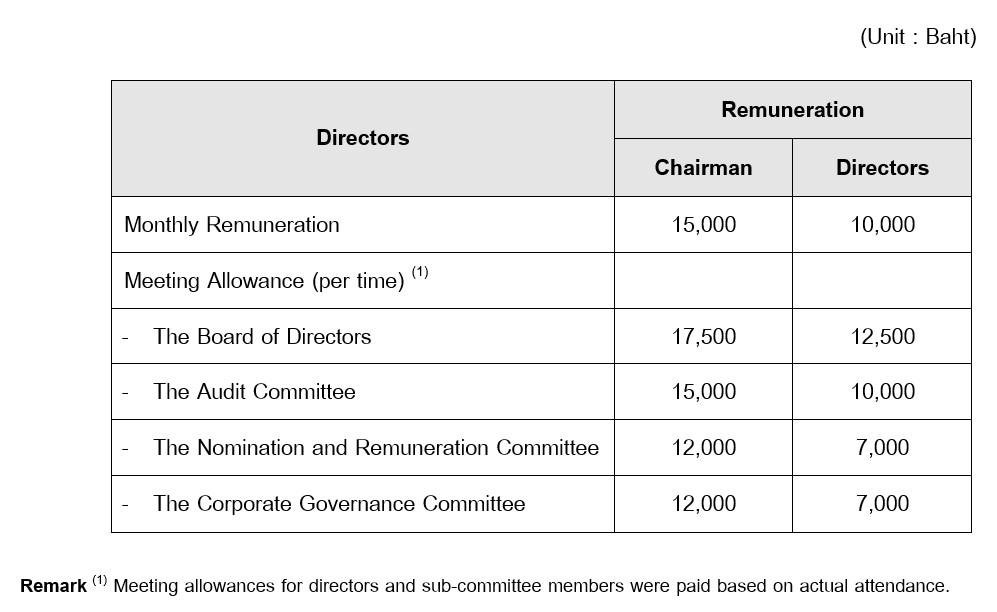
| Determination of Director Remuneration | The Board of Directors has established a Nomination and Remuneration Committee to nominate persons with appropriate qualifications to be directors, sub-committee members, Chief Executive Officer, and senior executives of the Company as well as consider the types and criteria for payment of remuneration to directors, sub-committee members in the Audit Committee, the Nomination and Remuneration Committee, the Corporate Governance, Risk Management and Sustainability Committee, Chief Executive Officer, and senior executives as deemed appropriate for their duties and responsibilities, work achievements linking with operating results and other related factors and benchmarking with other companies in the same or similar industry to propose its opinions to the Board of Directors and/or to the shareholders meeting for consideration and approval. 1. Monetary Remuneration The Annual General Meeting of Shareholders 2025 on 24 April 2025 has passed a resolution to determine remuneration for the Board of Directors, the Audit Committee, the Nomination and Remuneration Committee and the Corporate Governance Committee as follow:
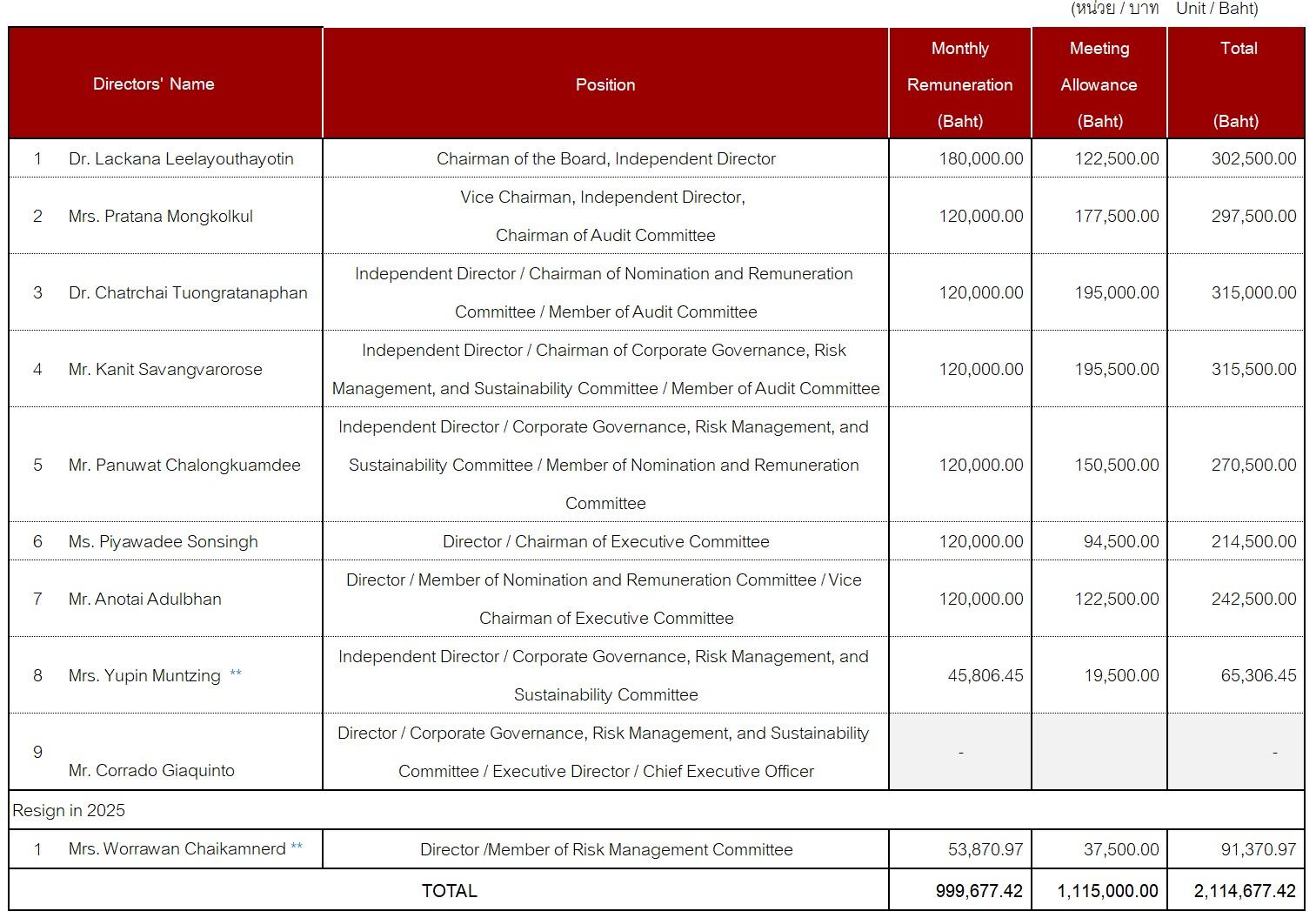
Those who are executive directors will not be entitled to such monthly remuneration and meeting allowances because they already are remunerated in their capacity as employees. For the year-ended 31 December 2025, the Company paid remuneration to directors with the amount of Baht 2,187,677.42 as monthly remuneration and meeting allowances, which the details are as follows:
2. Other remunerations and benefits -None – | |
| Independence of the Board of Directors from the Management | As role and duties of the Board of Directors as shown in item 7.2.3 and to ensure checks and balances between the Board of Directors and the management, the Company prescribes that the Chairman of the Board and the Chief Executive Officer are not the same person. The Chairman of the Board acts as the head of the Board of Directors in supporting the management’s operation, but is not involved in daily operation which is the duty of the Chief Executive Officer. The authority and duties of both positions are segregated as follows: Duties and Responsibilities of the Chaiman of the Board of Directors 1. Control the meeting to be effective in accordance with the regulations, Articles of Association, support and allow directors to ask questions and express their opinions independently. Take control of the discussions and summarize the resolution of the meeting. 2. The Chairman of the Board or the person assigned by the Chairman of the Board has the duty to call the meeting of the Board of Directors by sending the meeting invitation letter not less than 7 days prior to the meeting so that the directors have enough time to study, consider, and make the right decisions in various matters at the Board meeting. 3. Support and promote the Board of Directors to perform their duties to the best of their abilities according to the scope of duties and responsibilities and in accordance with good corporate governance principles. 4. Oversee and monitor the operation of the Board of Directors and sub-committees to achieve the objectives. 5. As the Chairman of the Board of Director Meeting and in the event that the votes are tied, the presiding Chairman is entitled to the casting vote. 6. Strengthen constructive relationships between executive directors and non-executive directors, as well as between the Board of Directors and the management team. Duties and Responsibilities of Chief Executive Officer 1. Monitor, manage, operate and conduct the regular business including oversee and control overall operation in accordance with the Company’s objectives and Articles of Association, regulations, policies, plans and budget approved by the Board of Directors and/or the shareholders’ meeting under the related laws and scopes defined by the Board of Directors. 2. Follow up, verify and evaluate the performances of the Company and its subsidiaries to ensure the good performances according to the goals set and report to the Board of Directors on a regular basis. 3. Determine visions, policies, business directions, strategies, business plans and budget of the Company and its subsidiaries to the Executive Committee and the Board of Directors. 4. Develop the organization’s good performance and operating results with consistent improvement for the sustainable growth. 5. Issue internal orders, announcements, and memorandums for the Company’s operation to be in line with the policy of the Board of Directors and for the benefits of the Company. Oversee the performance of the employees in accordance with the policies, rules, and regulations under the good governance principles. 6. Determine the organization structure, set up the procedures for recruiting, training, hiring, appointing, transferring and terminating employees. Determine the scope of duties and appropriate remuneration for employees in all levels and have duty to evaluate performance of top management level and lower. Chief Executive Officer has duty to present this organization structure to the Board of Directors for approval and take actions according to the approval by the Board. 7. Determine the trade agreement principles for the benefits of the Company. Consider, negotiate and approve any agreement and/or general business operation related within authorization and the amount set in Table of Authority. 8. Consider investment opportunity and/or new business investment, dissolution or joint investment thorough technical and financial studies appropriately and completely to support the decision making and to present and seek for approval from the Board of Directors. 9. Conduct other duties assigned by the Board of Directors and/or sub-committees and have authority to take necessary actions for the duties. 10. Sub-authorize and/or authorize other person to take action on behalf of the Chief Executive Officer within the scope of authority specified in the power of attorney and/or rules, regulations or resolutions of the Board of Directors and/or sub-committee and/or the Company guidelines for flexibility. | |
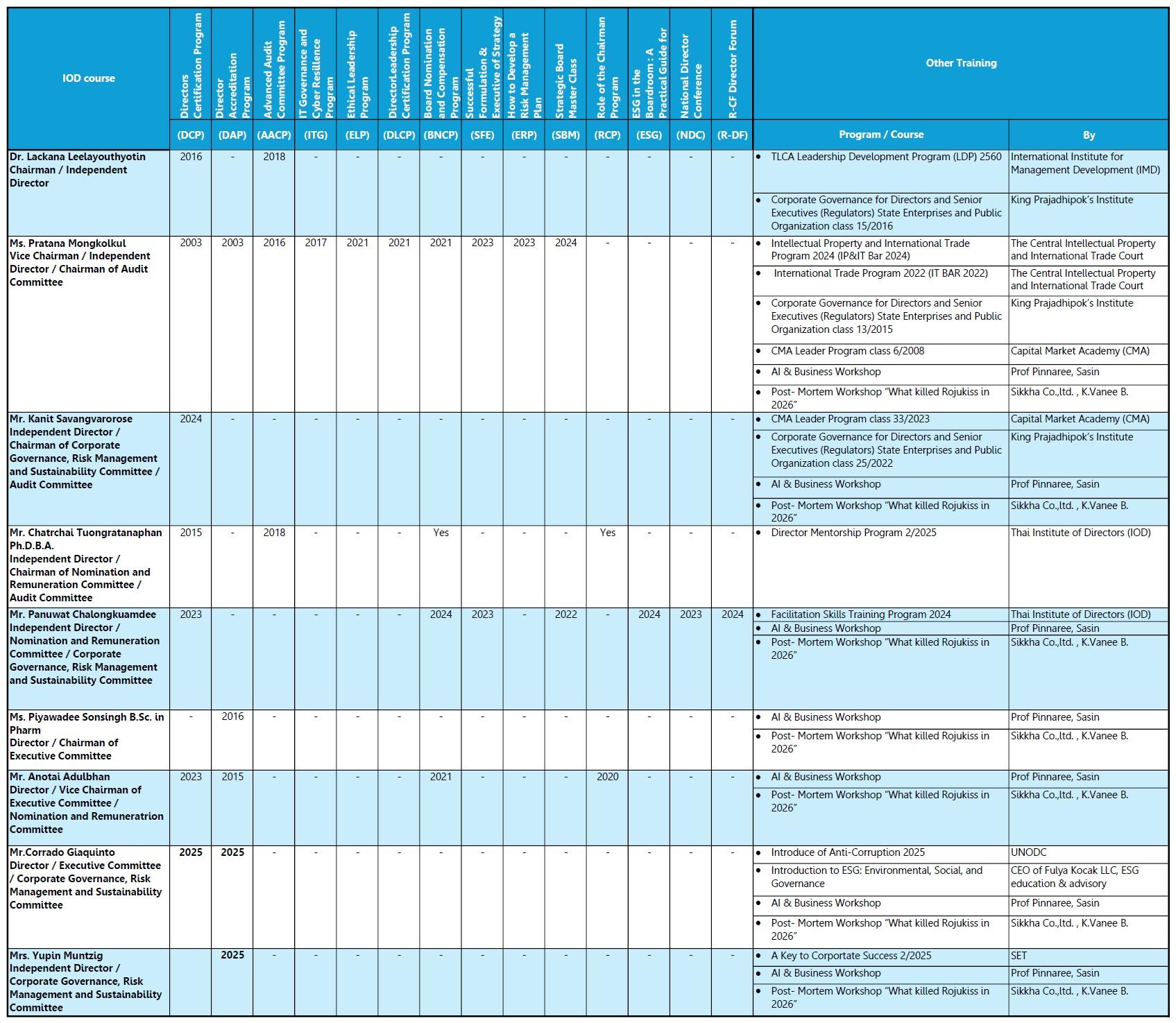
| Director Development | The Nomination and Remuneration Committee considers and prepares a director development plan to enhance and develop the knowledge and skills of the Company’s various boards and committees. The objective is to ensure a clear understanding of directors’ roles and responsibilities, the Company’s business, economic conditions, technology, laws and regulations relevant to the Company’s business, responsibilities toward stakeholders, and business ethics, with an emphasis on continuous training, including orientation programs for newly appointed directors. All directors, representing 100 percent of the total number of the Board of Directors, have completed the Director Certification Program (DCP) and/or the Director Accreditation Program (DAP) organized by the Thai Institute of Directors (IOD). The summaries of Directors' Trainings are as follows:
| |
| Board Performance Evaluation | As stipulated in the Company’s Board of Directors Charter and the charters of its sub-committees, the performance of the Board of Directors and its sub-committees is evaluated annually. The Company presents the results of such performance evaluations to the Nomination and Remuneration Committee and subsequently to the Board of Directors for acknowledgement. Recommendations derived from the evaluations are then used to further enhance the effectiveness of the Board’s performance. The Company conducted evaluations of the Board as a whole, individual directors, and the sub-committees, as detailed below: 1) Board Performance Evaluation (Board as a Whole) The performance evaluation of the Board as a whole comprises six assessment areas: (1) Board structure and qualifications, (2) Roles, duties, and responsibilities of the Board, (3) Board meetings, (4) Board dynamics and effectiveness in performing duties, (5) Relationship with management, and (6) Director development. 2) Individual Director Performance Evaluation The performance evaluation of individual directors comprises five assessment areas: (1) Personal qualifications, (2) Readiness to perform duties, (3) Participation in meetings, (4) Roles, duties, and responsibilities, and (5) Relationships with the Board and management. 3) Sub-Committee Performance Evaluation (both whole and individual) The performance evaluation of sub-committees comprises three assessment areas: (1) Structure and qualifications of the committee, (2) Committee meetings, and (3) Committee charter, roles, duties, responsibilities, and reporting. | |
| Corporate Governance of Subsidiaries and Associated Companies | The Company has set rules that the nomination and appointment of representatives to be directors in its subsidiaries and associated companies must be approved by the Board of Directors. The representatives appointed as directors in subsidiaries and associated companies are responsible for the best interests of those subsidiaries and associated companies. The representatives appointed as directors must be approved by the Board of Directors prior to voting or exercise the right to vote on important matters at the same level as requiring the approval of the Board of Directors if it is operated by the Company itself. The nomination of representatives in subsidiaries and associated companies is in proportion to the Company’s shareholding. In addition, in the case of subsidiaries, the Company has established regulations that representatives appointed by the Company must supervise the subsidiaries to have regulations on connected transactions, acquisition or disposition of assets or any other important transactions of the subsidiaries to be complete, correct and apply the rules relating to the disclosure of information and the above transactions in the same manner as the Company’s criteria. These include the need to supervise the data collection and accounting records of subsidiaries for the Company to be able to audit and prepare the consolidated financial statements on a timely basis. | https://www.rojukissinternational.com/en/governance/policies-and-corporate-documents |

Code of Conduct
Has a Business Code of Conduct
Yes
Code of Conduct Description
Stakeholders are valued by the organization, and they are treated with respect. In terms of corporate operations, it has a code of ethics. The following rules for working as a corporate representative will handle all stakeholders, including shareholders, employees, shareholders, customers, trading partners, the public, and society at large, in a transparent, appropriate, equitable, and fair manner:
6.2.1 Share holders, Investors, and analysts
The company treats all shareholders and investors fairly, and the Board of Directors, management, and all workers are expected to carry out their duties honestly and operate in an open and transparent manner. Maintain a focus on the company's shareholders' best interests. There will be no actions taken that could lead to a conflict of interest; no insider information will be used to gain an advantage for insiders and associates, and sensitive information will not be disclosed to third parties. Furthermore, the corporation respects and acknowledges the rights of all shareholders, including investors and analysts. To collect complete and consistent information about the company's operating results, the firm will convey the operating results and necessary information through the company's and related departments' operations.
6.2.2 Employees
The company's most significant resource is its employees. The company places a high value on rigorous adherence to labor regulations and social welfare and seeks to encourage all employees to have a positive attitude, a sense of duty and responsibility, pride in and belief in the organization, and a focus on teamwork. In addition, the company encourages employees to take part in training on topics that are both relevant and useful to their jobs. All employees receive annual health examinations, and the organization promotes safety and a pleasant working environment. The corporation provides adequate and suitable welfare in exchange for pay. Employee remuneration will be determined based on each employee's fair performance and compared to the company's performance in the short and long term in comparison to the same industry as well as allowing employees to register complaints in the event of unjust treatment through numerous routes, such as an opinion box or the Human Resources department receiving the complaint, etc. The company is responsible for ensuring that the workplace is safe, sanitary, and conducive to productive work.
6.2.3 Customers
Customers hold the company accountable for maintaining product quality and standards, as well as reacting to customers' needs as clearly and comprehensively as possible, in order to focus on long-term customer happiness and providing channels for the company's customers. The company is interested in hearing from customers who have a problem with a damaged product or a reason for dissatisfaction after using it. Customers will receive constant high-quality service from the business. Customers' rights should be explained to them, and the customers' interests should be protected.
6.2.4 Creditors
Build connections and treat creditors fairly by following to the principles of honesty, mutual trust, and trust, as well as being accountable for paying attention to and prioritizing the circumstances that have resulted in the best possible arrangement with creditors.
6.2.5 Business Partners
Treat the business partners with integrity and on an equal footing. This is to guarantee that the company's business operations are suitable, fair, and beneficial to both parties, as well as to ensure that the company's business operations are sustainable and that it is a long-term partner with the firm. The organization will select business partners based on a variety of factors, including price, quality, control, environmental protection, technical knowledge, legal compliance, trustworthiness, and a commitment to doing what is right. Furthermore, the organization must maintain ethical relationships with its partners and conduct business with them. Contracts, agreements, and business commitments must all be strictly adhered to. Maintain the privacy of the trading partners' information and do not use it for personal gain without their agreement.
6.2.6 Community, Society and Environment
The corporation is conscious of its social responsibilities and takes them seriously. As a result, the company operates on the premise of fostering shared values between business and society, with a focus on environmental protection through the promotion of resource efficiency and maximum benefit to help reduce energy consumption and prevent the company's operations from harming society, the community, and the environment. The company and its employees are committed to conducting business responsibly and in the best interests of society and community, as well as behaving in a friendly manner towards the communities in which they operate, helping and supporting the development of the community's well-being, and being accountable for the company's business operations in a fair and equitable manner to promote sustainable development.
6.2.7 Government and/or related government agencies
Manage the company's affairs to comply with all applicable rules and regulations, as well as assist government agencies with their various tasks as needed. Furthermore, the company is committed to providing high-quality goods while adhering to the law, which includes the duty to treat the government and other government agencies with political neutrality as outlined in the Charter, Code of Conduct, and Anti-Corruption Policy.
In addition, there will be a route for receiving complaints and/or comments via postal mail to the company's headquarters, and it will provide for whistleblower protection by not revealing but keeping whistleblower information confidential. The Internal Audit Department will first construct a summary of the situation and offer it to the Audit Committee for review and approval. If material that has an impact on the organization is discovered, it must be given to the Board of Directors for further consideration.
Code of Conduct Practices
| Guideline | Detail | Document Link | Page Number in Report |
|---|---|---|---|
| Prevention of Misuse of Inside Information | The Company has in place a policy to prevent conflict of interest based on prudence, honesty, rationale and independence within the ethical framework for the Company’s interests. The policy stipulates that a person who may have conflict of interest and/or a connected person as well as related parties involving in a transaction who discloses the information on the interests of his/her own and related parties to the Company for acknowledgement and have no authority to approve the transaction in which he/she has interests. The Company prescribes in the Board of Directors charter that the Board of Directors shall be responsible for ensuring non-conflict of interest between stakeholders of the Company and subsidiaries. In case that any director having conflict of interest in any transaction conducted with the Company or changes in his/her shareholding percentage, such director shall notify the Company immediately. Moreover, the assignment of authority, duties and responsibilities to any person shall not be characterized by the delegation of authority that allows the attorney to be able to approve the transaction that he/she or a person who may have conflict of interest may have interests or receive interests in any forms or have any other conflict of interest with the Company or subsidiaries, except for the approval of transactions which are conducted in accordance with the policy and the criteria approved by the shareholders’ meeting or Board of Directors. The Company has a policy on connected transactions and transactions having conflict of interests as in accordance with the laws and regulations of SEC, Capital Market Supervisory Board, and SET which will also be disclosed in Form 56-1 One Report. In 2025, the Company undertook the following actions regarding potential or actual conflicts of interest involving the Company:
| https://www.rojukissinternational.com/storage/download/corporate-policy-cg-report-and-download/20210705-kiss-conflict-of-interest-th.pdf | |
| Anti-corruption | The Company recognizes the importance of anti-corruption and is committed to operating business ethically within the goo corporate governance framework by adhering to good governance principles and Code of Conduct as well as responsibility for the society, the environment, and the stakeholders by ensuring business operations based on transparency, fairness, and accountability. The Company then developed a written anti-corruption policy which prescribes clear practice guidelines for operating business and transforming the organization into a sustainable organization. The policy was approved by the Board of Directors Meeting No. 3/2020 held on 22 June 2020. In 2025, the Board of Directors Meeting reviewed the said policy. The key points of the anti-corruption policy are as follows: • Not taking any action in all forms of corruption, giving, or accepting bribery to government agencies and private sectors or stakeholders of the Company in order to gain competitive advantage or for own benefit and other related persons’ interests including requesting or giving bribery for any inappropriate benefits. • Not neglecting or ignoring when seeing actions that are considered a corruption in relation to the Company. Employees must notify the supervisor or the person in charge and cooperate in the investigation of various facts. • The Company will provide fairness and protection for employees who refuse or report a corruption cases to the Company in accordance with the policy established. • Person who commits corruption are against the Company’s code of ethics. He/she must be therefore considered for disciplinary action in accordance with the regulations set by the Company and may be punished by law if his/her act is illegal. • The Company recognizes the importance of disseminating and educating people to ensure they understand on their duties for the Company or possibly affecting the Company in matters of compliance with the anti-corruption policy. Human Resource Department is responsible for communication, education and ensure those people understand clearly on this matter. • The Company ensures appropriate and efficient auditing and internal control processes are put in place both financial and accounting system, keeping record and others. Also ensures that there is a risk management system to prevent corruption. • The Company set up communication channels to publish the anti-corruption policy to employees of the Company and its subsidiaries and external parties such as director and new employee orientation, posts on the Company’s publicity signs, corporate website, annual report etc. to ensure all related parties understand all kind of corruption, risk of having relation to corruption and how to report corruption case. | https://www.rojukissinternational.com/storage/download/corporate-policy-cg-report-and-download/20210705-kiss-anti-corruption-th.pdf | |
| Whistleblowing and Protection of Whistleblowers | The Company is committed to the highest standards of ethical conduct, transparency, and integrity. This Whistleblower Policy provides a safe and confidential mechanism for employees and stakeholders to report any suspected wrongdoing, including violations of laws, regulations, internal policies, or human rights. It ensures that reports are addressed fairly, without fear of retaliation. Whistleblowers can report concerns through multiple confidential channels that will route the message to the Chairman of the Audit Committee (AC):
Rojukiss International Public Company Limited 100/8, 100/51-54 Vongvanich Complex B Tower, 12th, 19th floor Rama 9 Road, Huai Khwang, Huai Khwang, Bangkok 10310 | https://www.rojukissinternational.com/en/governance/whistleblowing-channel | |
| Preventing the Misuse of Inside Information | The Company conducts business under the principles of good corporate governance of the Stock Exchange of Thailand and places emphasis on the supervision of the use of inside information to be in accordance with the principles of good corporate governance. By adhering to these principles and ensuring the confidence of investors to receive equitable, timely and reliable information, the Company has established a policy of confidentiality, data protection and the use of inside information that all personnel shall be informed and follow procedures of confidential information protection. To prevent the disclosure of information and to identify the type of confidential information, the confidential documents and information must be managed and protected with specific methods accessible by both data creators and users. In addition, the Company places great emphasis on safeguard of customer and business information to be confidential. It is prohibited to disclose such confidential information of customers to employees and outsiders. In case that is necessary to disclose confidential information to the public, approval must be obtained from Chief Executive Officer. This prohibition shall include trading, transfer or acceptance of transfer of the Company’s securities by using confidential information and/or inside information and/or enter into any other juristic acts using confidential information / or inside information of the Company which causes damage to the Company either directly or indirectly. The Company’s directors, management and employees who receive inside information shall be prohibited from trading of the Company’s securities in a specific period, which has been complied since the year ended 2020 which is the first reporting period since the Company was listed in the Stock Exchange of Thailand. The Company Secretary and the Human Resource department shall notify those directors, management, and employees receiving inside information in advance to be aware of such prohibition period for trading of the Company’s securities. This shall include the prohibition of trading of the Company’s securities by oneself, spouses, minor children, whether it is direct or indirect trading (such as nominee or holding of securities through private funds) during the period when the Company is about to disclose significant information that may affect the Company’s share price such as 1 month prior to the date of disclosure of financial statements or operating results until 1 day after the date that the Company has disclosed financial statements or operating results to the Stock Exchange of Thailand to ensure that such information be disclosed to the public first. With this regard, the Company has established disciplinary penalty for those seeking benefits from the use of disclosure of the inside information causing damages to the Company, which may be penalized as required by law or by the Company through verbal warning, warning letter, probation, or termination of employment. Simultaneously, the Company has monitored and studied rules, regulations and relevant laws and informed the changes (if any) to its directors and management to strictly perform duties in accordance with changing rules, regulations, and relevant laws. For 2025, there were no incidents of violations relating to the misuse of inside information. | ||
| Giving or receiving gifts, entertainment, or business entertainment | In order to clarify the operation in matters that have a high risk corruption, directors, executives and employees in all level of the Company have to operate with cautious in these following topics: 3.1 Political Support The Company is politically independent and conducts its business without engaging in politics in any case. Therefore, the Company has no policy in supporting politics either directly or indirectly using money or any assets of the Company. However, the Company does not forbid directors, executives, and employees from participating in political activities undertaken under the constitution, but the participation must be on personal behalf without any negative association with the Company. 3.2 Charitable Donation and Financial Support The Company can do charitable donation in the form of financial support or other forms such as sharing knowledge etc. and be a part of social return activities and do not request any benefit in return from donator and do not expect return on business. In order to give support in any form either money or assets to any activity or project, the Company has to proceed with transparent and follow the laws and based on the approval process as per company’s policy. The objective of the support must be for public relation, support business, the Company’s image and not for bribery. The charitable donation and financial support need a clear and reliable evidence to ensure that the donation and financial support is not an excuse for corruption. 3.3 Gifts and Entertainment The Company allows directors, executives and employees to accept and pay money for gifts and entertainment that are unambiguous and are considered as normal business conduct or traditions or festive without impact to business operation or being a potential channel for corruption. The act must be in accordance with the Company’s regulations without violation of related laws and notifications or with the purpose to gain any advantage through a misconduct or to be an outright on hidden exchange to seek benefits in any form. Moreover, type and value of gifts must be reasonable and appropriate. Chief Executive Officer or the Audit Committee has duty to receive complaints, gather information, investigate and report to the Board of Directors for consideration and defining disciplinary action as appropriate. If such act is illegal, the person may be legally penalized. The decision of Chief Executive Officer or the Audit Committee is considered final. | ||
| Compliance with laws, rules and regulations | The Company strictly complies with all relevant laws, regulations, and requirements as stipulated in its Charter, Code of Conduct, and Corporate Ethics and Work Practices. These serve as the guiding framework for business operations for directors, executives at all levels, employees, and all related parties. The details are as follows: Code of Conduct for the Company’s Business Operations 1.1 Conducting Business in Compliance with the Law
1.2 Conducting Business that Benefits the Economy, Society, and the Environment
Code of Conduct for Directors, Executives, and Employees Directors, executives, and employees of the Company are expected to conduct themselves in accordance with the Company’s business ethics by performing their duties in compliance with the Company’s rules, regulations, objectives, and articles of association, as well as resolutions of the Board of Directors and shareholders’ meetings. They must also strictly adhere to all applicable laws, rules, and regulatory requirements related to the Company’s business operations. | https://www.rojukissinternational.com/storage/download/corporate-policy-cg-report-and-download/20210705-kiss-code-of-conduct-th.pdf | 2-3 |
| Use and maintenance of data and assets | Guidelines for the Safekeeping of Internal Information1. Classification of Information ConfidentialityInternal information constitutes the Company’s trade secrets and must be protected from disclosure to external parties. Such information may be classified into several levels according to its significance, including public information, restricted information, confidential information, and highly confidential information. The sharing and use of internal information shall be strictly limited to the scope of duties and responsibilities assigned to each individual. 2. Disclosure of Information to External PartiesAny disclosure of confidential information to the public must be approved by the Chief Executive Officer. The Chief Executive Officer may personally provide such information where it is deemed highly material, or may delegate the responsibility to an authorized person. The Company shall designate a person responsible for public disclosure, including investor relations and coordination with investment-related agencies, who shall work in collaboration with the relevant internal information owners. 3. Expression of Opinions to External PartiesThe Company’s personnel shall not respond to inquiries or express opinions to any external parties unless such actions fall within their duties or they have been duly authorized. If not authorized, personnel shall politely decline to provide any comments or opinions. Guidelines on the Use of Inside InformationThe Company shall provide training and awareness to members of the Board of Directors and executives, including executives in accounting or finance functions at the department manager level or equivalent, as well as the Company’s auditors, regarding their duties to prepare, disclose, and submit reports on the holding and changes in holdings of securities of themselves, their spouses or de facto spouses, and their minor children to the Office of the Securities and Exchange Commission (SEC), in accordance with the Securities and Exchange Act and relevant rules, regulations, notifications, and orders issued by the SEC, the Capital Market Supervisory Board, and the Stock Exchange of Thailand (collectively, the “Securities Laws”), including applicable penalties. The Board of Directors, executives, executives in accounting or finance functions at the department manager level or equivalent, and the Company’s auditors are required to prepare, disclose, and submit reports on their securities holdings and any changes therein, including those of their spouses or de facto spouses and minor children, to the Company Secretary prior to submission to the SEC. Such reports must be submitted within 30 days from the date of appointment as a director and/or executive, or within three (3) business days from the date of any purchase, sale, transfer, or receipt of transfer of securities. The Company recognizes its responsibilities toward shareholders and stakeholders in accordance with good corporate governance principles. To enhance confidence among shareholders, investors, and all relevant parties, the Company has established measures governing the use of inside information to ensure fairness and equality. Accordingly, the Company strictly prohibits personnel at all levels, as well as their family members who become aware of inside information, from using material non-public information that may affect the price or value of the Company’s securities for any of the following purposes:
In addition, the Company prohibits the aforementioned personnel and their family members from disclosing material non-public information to others for the purpose of enabling such persons to benefit therefrom. The Company considers any improper use of inside information for securities trading to constitute speculative trading or the creation of unfair advantages for certain groups, which is deemed an offense under applicable laws and a disciplinary violation. Furthermore, the Company has established additional measures to prevent insider trading by requiring directors and executives, including executives in accounting or finance functions at the department manager level or equivalent, who are in possession of material inside information affecting the price or value of securities, to refrain from trading the Company’s securities during the period prior to the disclosure of financial statements or information regarding the Company’s financial condition and status, until such information has been publicly disclosed. The Company shall notify directors and executives in writing to suspend trading in the Company’s securities at least 30 days prior to public disclosure and recommends waiting at least 24 hours after such disclosure. Disclosure of such material information to other persons is strictly prohibited. In addition, directors, executives, and employees of the Company are required to strictly comply with the Company’s Code of Conduct, the guidelines on the use of inside information under the Securities Laws, the Public Limited Companies Act, and other relevant regulations. In 2025, the Company implemented the policy on the use of inside information as follows:
| ||
| Cyber security | To ensure effective compliance with this policy, the Company has established the following computer system and information security measures: 1. The Company’s computers and information technology systems shall be used in compliance with the laws governing computer-related offenses and other applicable laws. 2. Access to non-public information shall be restricted and limited, to the extent practicable, to directors, the Chief Executive Officer, and relevant executive management only. Disclosure to the Company’s employees shall be made strictly on a need-to-know basis, and employees shall be informed that such information is confidential and subject to usage restrictions. 3. Any unauthorized alteration, duplication, deletion, destruction, or disclosure of the Company’s data, including information contained in the Company’s information systems, is strictly prohibited. 4. Workplace security measures shall be implemented to prevent unauthorized access to and use of confidential files and documents. 5. User accounts (Usernames) and passwords must be properly safeguarded and must not be shared with others. Disclosure, distribution, or allowing others to become aware of such credentials is strictly prohibited. 6. The use of the Company’s email system to transmit defamatory, damaging, offensive, obscene, threatening, harassing, or otherwise unlawful messages or images is strictly prohibited. 7. Owners of non-public information must ensure that all relevant parties strictly comply with the established information security procedures. 8. Information security operations and management shall comply with applicable laws, regulatory requirements, internal rules, and contractual obligations. 9. Where access to the Company’s information systems and data is granted to external persons or entities, such access must be solely for legitimate business purposes. Appropriate contractual provisions shall be in place to safeguard information security, and such external persons or entities shall access the systems and information only upon authorization by the Company. | ||
| Environmental management | The Company integrates sustainability across four key dimensions: environmental, social, governance, and economic, with a strong commitment to delivering measurable performance, transparent reporting, and continuous improvement. Environmental
| ||
| Human rights | Rojukiss International PLC (“Rojukiss” or “the Company”) is committed to respecting and promoting human rights in every aspect of our operations. We recognize the inherent dignity of all individuals and commit to operating our business in a manner consistent with the United Nations Guiding Principles on Business and Human Rights, the Universal Declaration of Human Rights, the International Labour Organization (ILO) Core Conventions, and relevant Thai laws and regulations. We believe that a commitment to human rights is essential to sustainable growth, responsible business conduct, and our long-term success in the skincare and personal care industry. Rojukiss is committed to: 1. Non-Discrimination and Equal Opportunity We promote a workplace free from discrimination, harassment, or bias based on race, gender, age, religion, disability, sexual orientation, nationality, or any other status. Employment decisions are based on merit, qualifications, and business needs. 2. No Forced or Child Labor We strictly prohibit the use of forced labor, bonded labor, human trafficking, or child labor in any part of our business or supply chain. We comply with Thai labor laws and international standards regarding the minimum age of employment. 3. Fair Wages and Working Conditions We ensure fair compensation, working hours, and benefits in line with Thai labor law and market standards. Safe and healthy working environments are maintained for all employees. 4. Freedom of Association We respect the rights of employees to form, join, or not join trade unions and to bargain collectively in accordance with applicable laws. 5. Health and Safety We are committed to providing a safe, hygienic, and secure workplace. Regular risk assessments, training, and corrective actions are conducted to prevent workplace hazards. 6. Privacy and Data Protection We respect and protect the privacy and personal data of our employees, consumers, and partners. We ensure compliance with the Personal Data Protection Act (PDPA) of Thailand. 7. Responsible Marketing and Product Safety We uphold consumer rights through transparent communication, safe products, and honest marketing claims. Rojukiss products comply with Thai FDA regulations and international cosmetic safety standards. | https://www.rojukissinternational.com/storage/download/corporate-policy-cg-report-and-download/20210705-kiss-anti-corruption-th.pdf | |
| Occupational health and safety | The Company places great importance on employee well-being in all dimensions, with a strong focus on safety, welfare, and quality of working life. These efforts aim to ensure that employees can perform their duties effectively in a work environment that supports both physical and mental well-being. In 2024, the Company implemented the following key measures related to employee safety and welfare: 1) Occupational Safety and Employee Welfare 1.1 Work from Home Policy The Company has introduced a Work from Home policy for office-based employees, allowing them to work remotely every Wednesday. This initiative aims to promote work-life balance, reduce commuting burdens, and enhance work efficiency. Employees are still able to attend meetings and coordinate effectively through online communication platforms. 1.2 Indoor Air Quality Improvement Measures To safeguard employee health and reduce risks associated with air pollution, the Company installed air purifiers in common office areas, particularly during periods of high PM2.5 levels. In addition, the Company conducts regular Big Cleaning Days and performs routine cleaning and maintenance of air conditioning systems to ensure a clean and safe working environment. 1.3 Safety Measures and Warehouse Area Improvements The Company places strong emphasis on the safety of employees working in warehouse areas and has implemented various safety measures accordingly. 2) Provision of Annual Work Equipment In response to the increase in the number of warehouse employees and to comply with occupational safety and hygiene standards, the Company has procured and provided additional work equipment to ensure that all employees are adequately and appropriately equipped. The equipment provided includes:
3) Warehouse Area Improvements To accommodate the growing number of employees and improve operational organization, the Company upgraded warehouse facilities by establishing designated storage and preparation areas prior to entering the warehouse. This allows employees to conveniently change and prepare safety equipment, reduces confusion in equipment usage, and helps maintain cleanliness. The Company also conducts regular inspections and maintenance of facilities, including:
4) Safety Training and Awareness The Company regularly provides safety training for warehouse employees to ensure they understand safety measures and can comply with established guidelines correctly and safely. The Company remains committed to continuously enhancing employee welfare and safety, ensuring that employees can work in a safe, healthy, and supportive environment that promotes efficiency and sustainable performance. |
Promoting Compliance with the Code of Conduct
Promotes Compliance by Directors, Executives and Employees
Yes
Description
The Company has provided continuous communication and training to its personnel to ensure a genuine understanding of anti-corruption measures, the Company’s expectations, and the penalties for non-compliance with such measures. Examples include training on anti-bribery and anti-corruption for newly hired employees as part of the orientation program, as well as communication to all employees through the Company’s notice boards.
In 2026, the Company plans to communicate the Code of Conduct, the Code of Business Conduct, and the Anti-Corruption Policy through the orientation program for new employees, which includes a formal acknowledgment of such policies. In addition, the Company will communicate these policies to existing employees through the e-learning system.
Anti-Corruption Networks & Projects
Joined or Declared Intent to Join Anti-Corruption Networks
No
Networks & Projects Joined
| Network / Project |
|---|
| Thai Private Sector Collective Action Against Corruption: CAC |
| United Nations Global Compact (UNGC) |
| Participation of anti-Corruption networks and initiatives |
Material Changes & Developments in CG
Reviewed the CG Policy or Board Charter in the Past Year
Yes
Material Changes or Developments in the Past Year
Yes
Policy Review — Description
During the past year, the Company reviewed and enhanced its corporate governance policies and practices as follows:
(1) The consolidation of sub-committees by merging the Corporate Governance and Sustainability Committee and the Risk Management Committee into a single committee, namely the Corporate Governance, Risk Management, and Sustainability Committee. The Charter of the said sub-committee was also revised to clearly define its roles, duties, and responsibilities, as detailed in Section 7.3.
(2) The establishment of the Human Rights Policy, the Risk Management Policy, and the Sustainability Policy.
(3) The enhancement of the whistleblowing and complaint handling policy, as well as the review and revision of the Anti-Corruption Policy and the Corporate Social Responsibility Policy to ensure consistency and alignment.
(4) The review of the Charters of the Board of Directors and its sub-committees, namely the Audit Committee, the Nomination and Remuneration Committee, and the Executive Committee.
(5) The revision of the performance evaluation forms for the Board of Directors and its sub-committees to further enhance the effectiveness and efficiency of the Board’s performance.
(6) To formally notify the Board of Directors and executives, including executives holding managerial-level positions or equivalent in the accounting or finance functions of the Company, to refrain from trading the Company’s securities in writing for a period of at least 30 days prior to the public disclosure of information and for 24 hours after such information has been disclosed to the public, and to prohibit the disclosure of such material information to any other persons.
Implements the CG Code for Listed Companies
No
CG Code — Description
The activities to support the disclosure of material information concerning the Company in an accurate, sufficient, equitable, and timely manner, as well as to promote shareholder engagement and confidence, as follows:
(1) The disclosure of material information relating to the Company’s operations and business undertakings.
The Company has an Investor Relations function that serves as the contact point of communication between shareholders and the Company. Its responsibilities include the disclosure of material and relevant corporate information for investment decision-making in accordance with disclosure requirements and the Investor Relations Code of Ethics. The function also provides opportunities for both retail and institutional shareholders to raise inquiries and offer constructive suggestions to management, as well as to receive operational information useful for investment consideration. In addition, the Company organizes and participates in activities on a regular basis to foster and maintain good relationships between the Company and all groups of shareholders.
For the year 2025, the Company regularly presented its operating performance, financial information, and non-financial information through various channels, with details as follows:
1. Company executives provided operating performance information and responded to inquiries from analysts, investors, and shareholders through the following activities:
Company visits or on-site meeting: 4 times
Online information inquiries via conference calls: 1 time
Analyst meetings: 3 times
SET Opportunity Day: 4 times
2. The Board of Directors encourages the use of information technology for information disclosure. The Company prepares disclosure documents in both Thai and English for public access and publishes them on the Company’s website at https://investor.rojukissinternational.com/th/home, as well as through the Stock Exchange of Thailand’s channels, as follows:
Management Discussion and Analysis (MD&A) reports provided to investors and securities analysts on a quarterly basis
Disclosure of key financial statement information in accordance with the accounting period through the FSCOMP system of the Stock Exchange of Thailand, with Financial Highlights displayed in the SETSmart system
Quarterly investor presentation materials provided to investors and analysts
Preparation of a Company Factsheet for shareholders and investors, summarizing key corporate information each quarter to facilitate understanding of the business overview, operating performance, and growth plans
Preparation of an Investor Relations Calendar on the Company’s website
3. Organization of information briefings and press conferences for the media: 2 times
In addition, the Investor Relations function conducts a quarterly investor satisfaction survey (Investor Feedback) to gather input for the continuous development and improvement of Investor Relations effectiveness.
To prevent the leakage of inside information around the period of earnings announcements and to comply with good corporate governance principles, the Company has established a silent period during which it refrains from communicating with analysts and investors and from providing information relating to operating results. The silent period is set for 1 month prior to the announcement of operating results for each quarter.
(2) Shareholders’ Meeting in 2025
In 2025 the Company arranged Shareholders’ Meeting for shareholders’ rights as following details: The Company’s Board of Directors determined that the Annual General Meeting (AGM) of Shareholders shall be held annually within four months from the end of the Company’s fiscal year. If there is a need to consider special matters related to shareholders' rights and interests. The Board will call an Extraordinary General Meeting (EGM) as necessary and appropriate. The Company complies with best practices as outlined in the AGM Checklist promoted by the Thai Investors Association for organizing shareholder meetings.
2025 Annual General Meeting (AGM) of shareholder
In 2025, the Company held its Annual General Meeting (AGM) on Thursday, April 24, 2025, via electronic Meeting (e-AGM) only, following best practices recommended by the AGM Checklist of the Thai Investors Association. The Company emphasized shareholders' rights and equitable treatment in line with good corporate governance principles. Before the Shareholders’ Meeting The Company invited shareholders to propose meeting agenda items and nominate candidates for directorship in advance from December 20, 2024, to January 31, 2025. The criteria and procedures were published on the Company's website and via the SETLink disclosure system of the Stock Exchange of Thailand. No shareholders submitted agenda items or director nominations during this period. The Company published the invitation letter of AGM, along with Proxy Forms A, B, and C, on Company’s website on April 2, 2025, which was 22 days in advance of the meeting date. Shareholders were encouraged to review the information and submit questions in advance through the Company’s website. The Company also supported the use of proxy forms that shareholders should vote directly. At least one independent director was proposed as an alternative proxy for shareholders. Therefore, the notification to disclose the said invitation letter of AGM was announce via SETLink of the Stock Exchange of Thailand. The invitation letter of AGM and enclosed documents were prepared in both Thai and English. The Company assigned Thailand Securities Depository Co., Ltd. (TSD), its share registrar, to send the invitation letter of AGM via registered mail on April 9, 2025, which was 15 days prior to the meeting. The invitation letter clearly stated the date, time, format, and agenda, specifying whether each agenda was for acknowledgment or approval. It also included the Board's opinions, the Company’s annual report of 56-1 one report (via QR Code), financial statements, details and document requirements including step for registration, proxy forms, procedures for submitting questions in advance, and personal data protection. The invitation letter of AGM was also published on the Company’s website at https://investor.rojukissinternational.com from April 2, 2025.
The Company facilitated institutional shareholders and custodians by allowing them to submit proxy forms and shareholding documents in advance. For those who authorized independent directors as their proxies, the Company returned signed proxy forms after the meeting for verification purposes.
On the Day of the 2025 AGM (April 24, 2025)
The 2025 AGM was held via electronic meeting (E-AGM) at 9:00 a.m., hosted from the Company's meeting room at 100/8, 100/51-54 Vongvanich Complex B, 12th and 19th Floors, Rama 9 Road, Huai Khwang, Bangkok 10310. At the start of the meeting, there were 15 shareholders attending in person, holding a total of 118,995,601 shares and 13 proxies, representing 215,692,153 shares, totaling 28 shareholders, collectively holding 334,687,754 shares, which was 55.7804% of the Company’s total paid-up shares (600,010,000 shares), as a quorum according to the Company’s Articles of Association. All 9 directors (100%) attended the meeting, including: Chairman of the Board, Chairpersons of the Audit Committee, Risk Management, Nomination and Remuneration, Corporate Governance and Sustainability Committees, Chief Executive Officer (CEO), Chief Financial Officer, Chief Sales Officer, Chief Marketing Officer, and Chief Supply Chain Officer. Additionally, 2 external auditors and 2 independent legal advisors attended as observers and vote-counting verifiers to ensure transparency and legal compliance. Their names were recorded in the AGM minutes, which are available on the Company’s website. The meeting was also recorded VDO in full.
Shareholder Rights and Voting
• Shareholders could pre-register at least 7 days before the meeting and join the virtual meeting room 1 hour in advance. The e-AGM system supported various devices such as smartphones, computers, laptops, and tablets. • Shareholders unable to attend could appoint another person or an independent director as a proxy. The Company proposed two independent directors for proxy, namely: Mrs. Pratana Mongkolkul, and Mr. Chatrchai Tuongratanaphan, D.B.A. Their profiles were included in the AGM documents.
• The Chairman of the Board acted as Chairman of the Meeting, conducting the meeting in accordance with the Articles of Association. Agenda items were considered in the sequence listed in the AGM notice with no reordering. However, after the meeting had completed the consideration of all agenda items as originally prescribed, a proposal was submitted to the meeting for approval to add an additional agenda item, namely, to consider and ratify an investment in another company resulting in such company becoming a subsidiary of the Company, pursuant to Section 105, paragraph two, of the Public Limited Companies Act B.E. 2535 (1992)
• The Company Secretary ensured accurate all data and moderator who assigned by the Chairman of the Meeting would announce quorum, instructions on voting and vote-counting procedures.
• Technology and sufficient personnel were provided to facilitate registration and vote counting for each agenda item with accuracy and transparency. For director elections, votes were cast on an individual basis.
• The Chairman allowed shareholders to express opinions and ask questions before voting on each agenda. All inquiries and suggestions were recorded in the meeting minutes.
• Voting results were announced after each agenda. In case of delays in vote-counting, the meeting proceeded with the next agenda item to avoid interruptions. Voting results included approval, disapproval, and abstentions. No objections were raised on any resolutions.
• Shareholders, who joined after the meeting started, could still vote on agenda items not yet resolved, and their votes were counted towards the quorum from the time of their entry.
After the Meeting
• The Company Secretary recorded the resolutions and voting results for each agenda in both Thai and English and disclosed them via SETLink on the same day of the Meeting. The said results were also posted on the Company’s website. The Company maintained a secure system for vote recording and verification.
• A detailed AGM Minutes was prepared by the Company Secretary, including: Names of participating directors, Key explanations and answers, Voting methods and procedures, Summary of comments, questions, and suggestions, Vote counts (approval, disapproval, abstention) complying with the good corporate governance of Stock Exchange of Thailan. The minutes were signed by the Chairman of the Board (“Chairman of the Meeting) and submitted on May 7, 2025 to the Stock Exchange of Thailand within 14 days from the AGM date. The AGM Minute in Thai and English were published on the Company’s website, allowing shareholders to review and provide feedback within 1 month of publication. A copy was also submitted to the Department of Business Development, Ministry of Commerce, within the required legal timeframe.
Other CG Performance & Outcomes
The Company was rated at the “Good” level (3-star rating) under the Corporate Governance Report of Thai Listed Companies, as conducted by the Thai Institute of Directors Association.
The Company received a “Fair” rating under the Shareholders’ Meeting Quality Assessment Project conducted by the Thai Investors Association.